

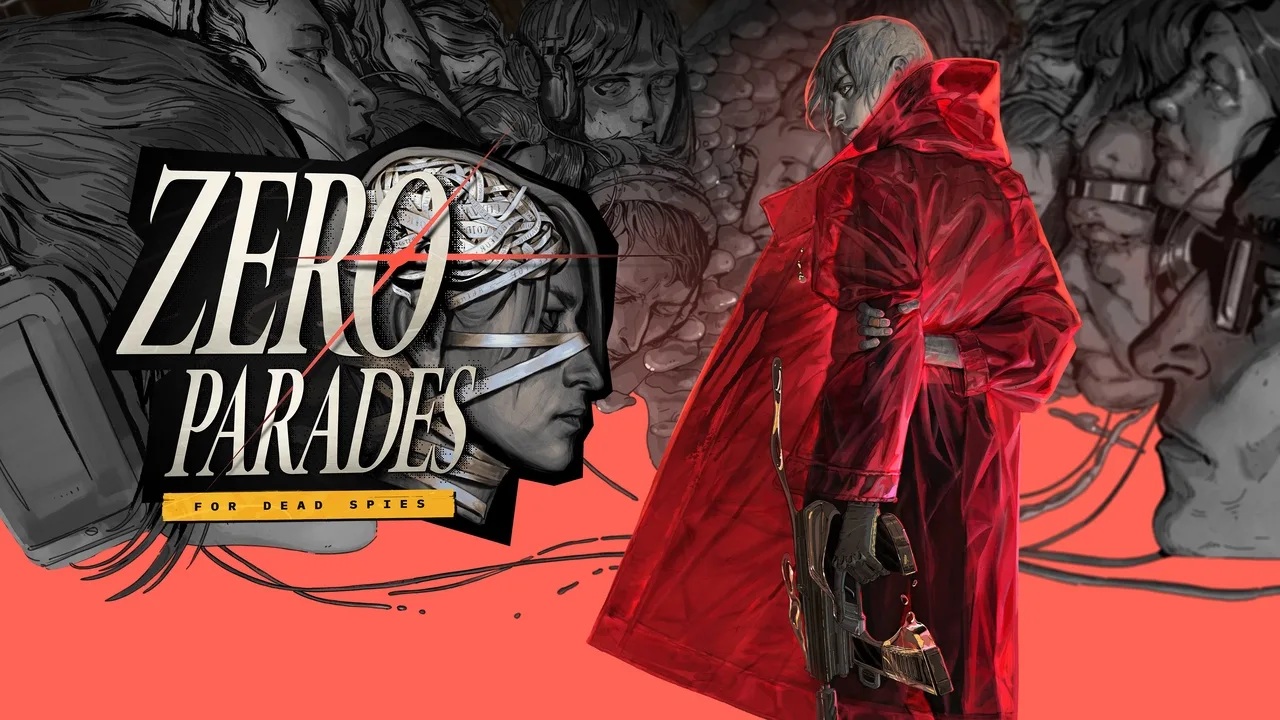
Spy stories occupy an oversized space in our cultural memory; power fantasies of violence, sex and intrigue, where slick agents thwart their enemies through a little bit of cunning and a lot of luck. But more than that, they’re stories about identities – the values that we choose to wear as masks and the ones we wear closer to our hearts. Zero Parades: For Dead Spies is a game that’s interested in exploring the dissonance between spies as extensions of their governments, and spies as thinking and feeling individuals, a feat that it gracefully accomplishes through its interplay of taut storytelling, playful mechanics, and heady themes. Some frayed edges sit along this tangled web of intrigue, but the sheer confidence with which developer ZA/UM combines these elements helps to keep their sophomore effort from unravelling.
I’ll add that the purpose of this review isn’t to relitigate ZA/UM or the legacy of their first release Disco Elysium; there’s already a surfeit of articles and video essays doing just that. You can acknowledge that the businesspeople that hollowed out an art collective are still major stakeholders at the company, but you can also acknowledge that the game is made by artists and programmers who have crafted something compelling and that they deserve to be recognised and compensated for it. Both of those realities can be true and you can hold them in your head and your heart at the same time and never reconcile them – and it’s okay to feel that way. It means you’re thinking about it, which is more than can be said about most gamers. Oddly enough, the cognitive dissonance on display also dovetails well with the themes explored by the game itself.
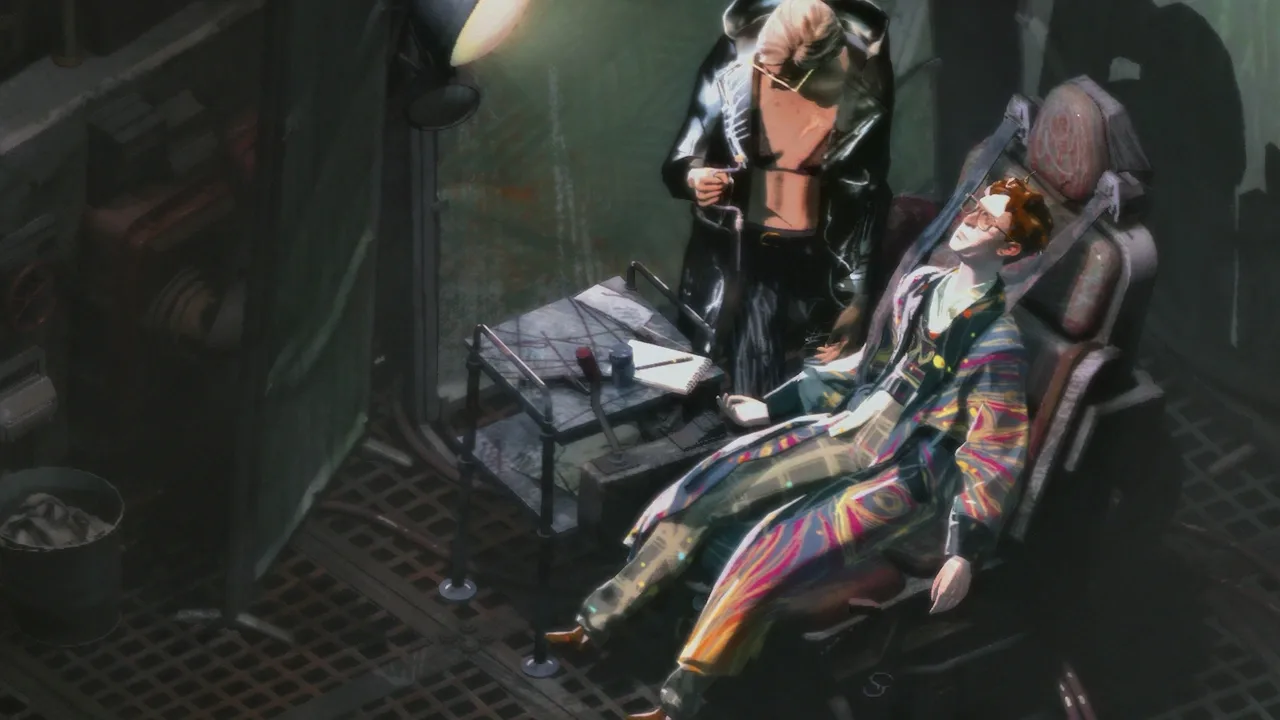
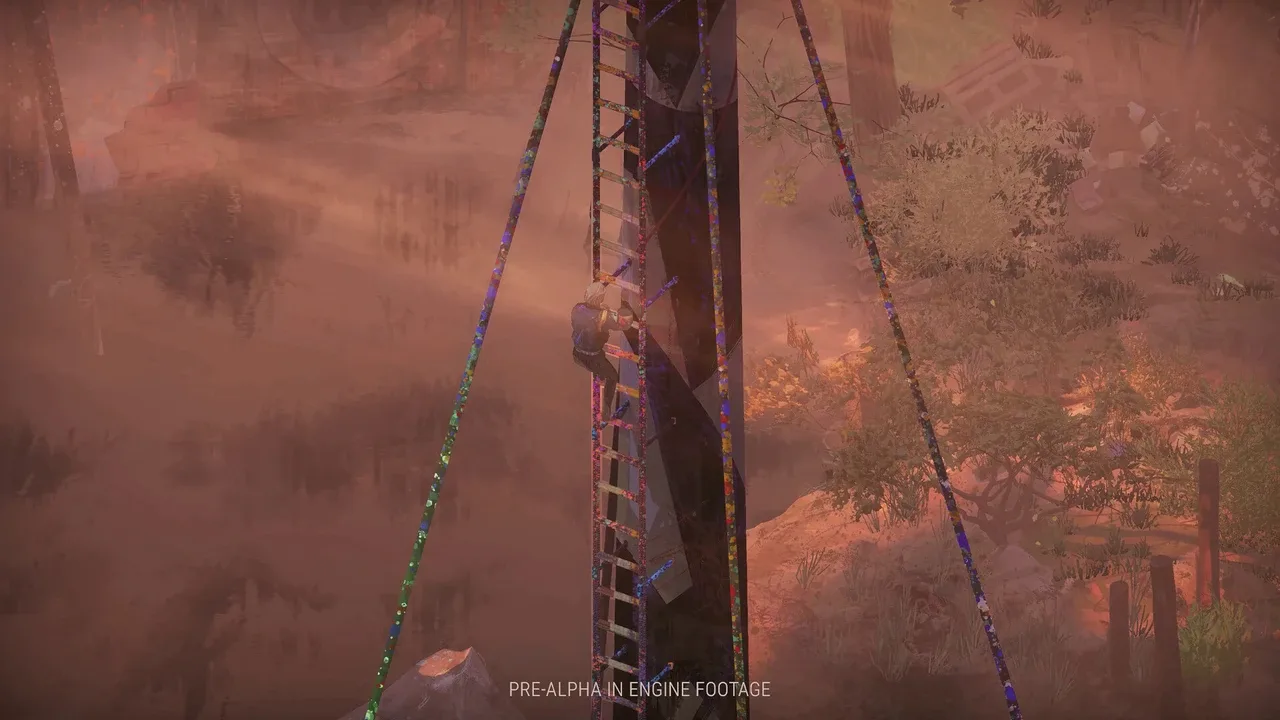
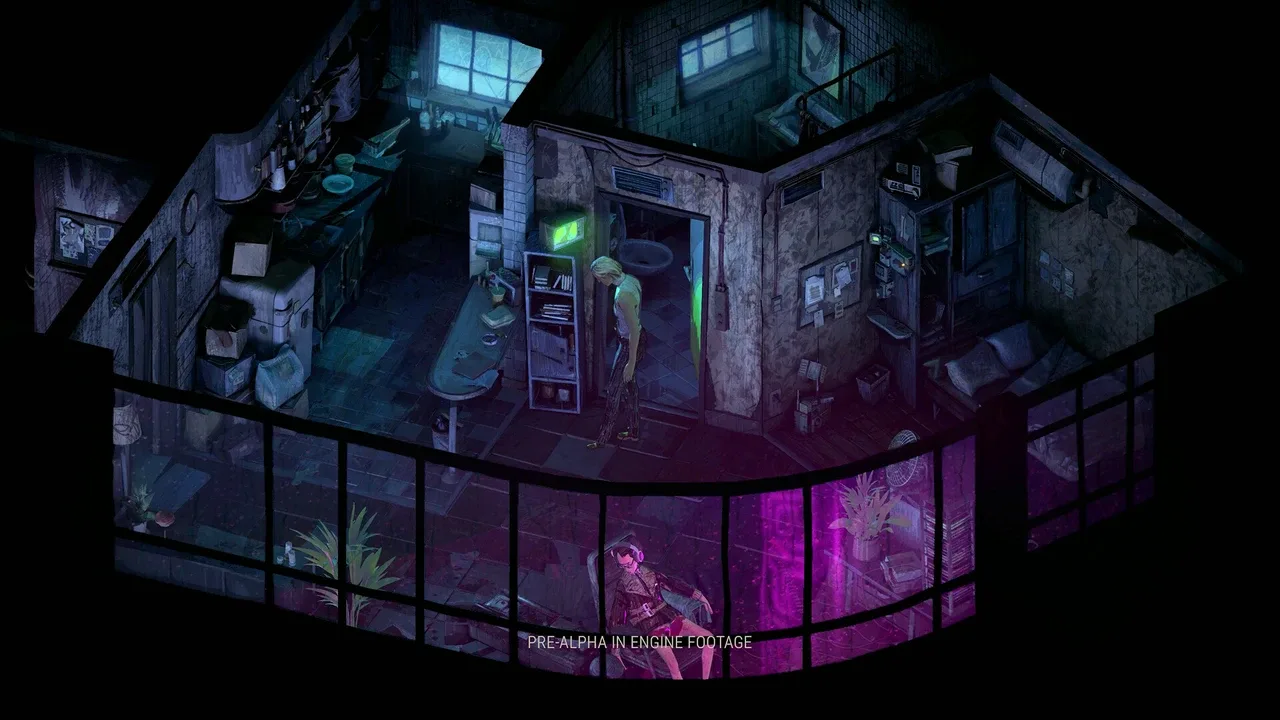
Zero Parades casts you as Hershel Wilk, cryptonym CASCADE, an absolute train wreck of a human being and a questionably effective spy, returning to the scene of an operation that went so monumentally wrong that all her assets were burned and she was put on ice for five years. Things haven’t gone much better this time around either though: your partner is comatose with his pants around his ankles in a dingy apartment, with the only apparent source of his affliction being the music of a pop superstar. It’s a strong start and leaves ample room for conspiracies to fractal outward, as the game’s dense cast of characters attempt to thumb the scale of consensus reality to read more in their favour.
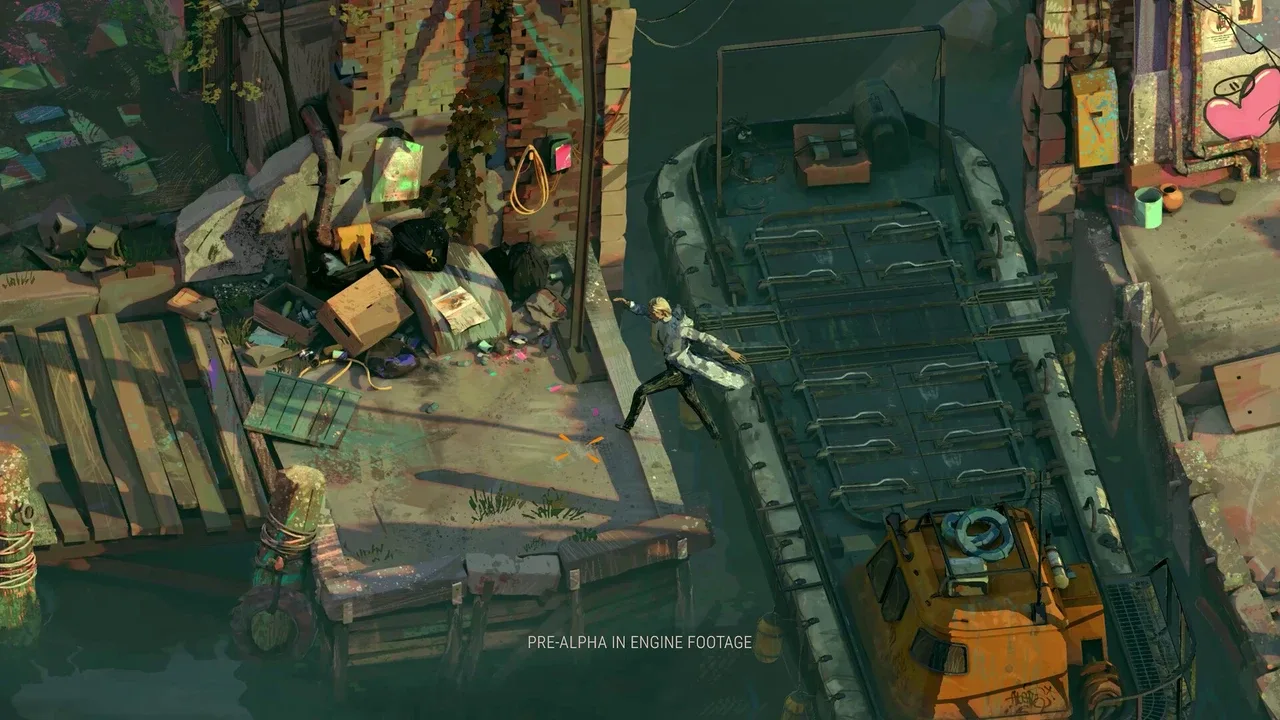
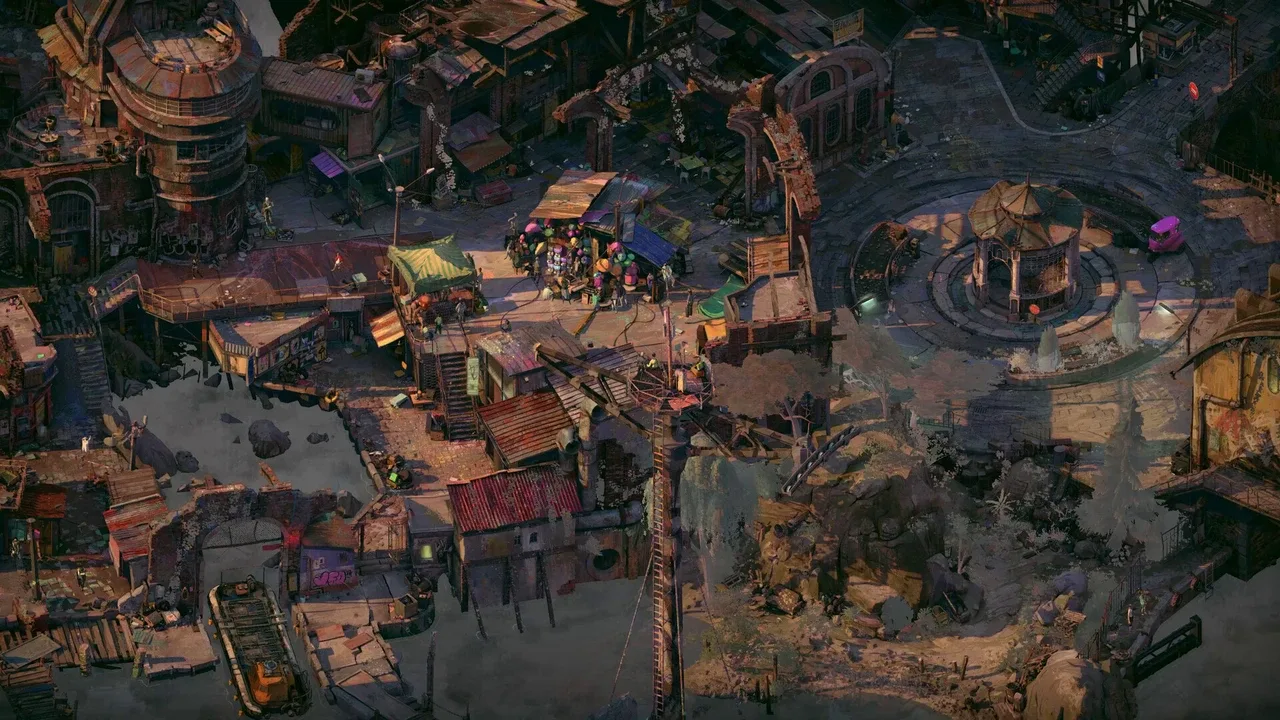
The backdrop for your mission is the island of Portofiro, a geopolitical crucible. Not only is it a major artery for shipping lanes, but the nation’s messy past provides leverage for the world’s three major players to shape the course of history. For the international bank of L’Empire Sans Terretoire, it serves as an object lesson of the success of the free market, with crushing loans having locked the country into an endless cycle of debit and credit. For the techno-fascist nation of La Luz, the slow trickle of its cultural exports through a strict blockade is proof positive of the superiority of its culture. Lastly there’s your faction, the communist Superbloc, which has grown too large and stagnant to have any political will of its own outside of being purely reactive to other threats.
If all of this sounds incredibly dense, it’s because it is. Zero Parades never sits you down to unravel any of this at length either. It trusts the player enough to have the patience and curiosity to piece it all together themselves. It’s a refreshing change of pace from the standard lore dumps that underpin most video game worldbuilding, and a feature of Disco Elysium’s writing that has only grown stronger and more self-assured here.
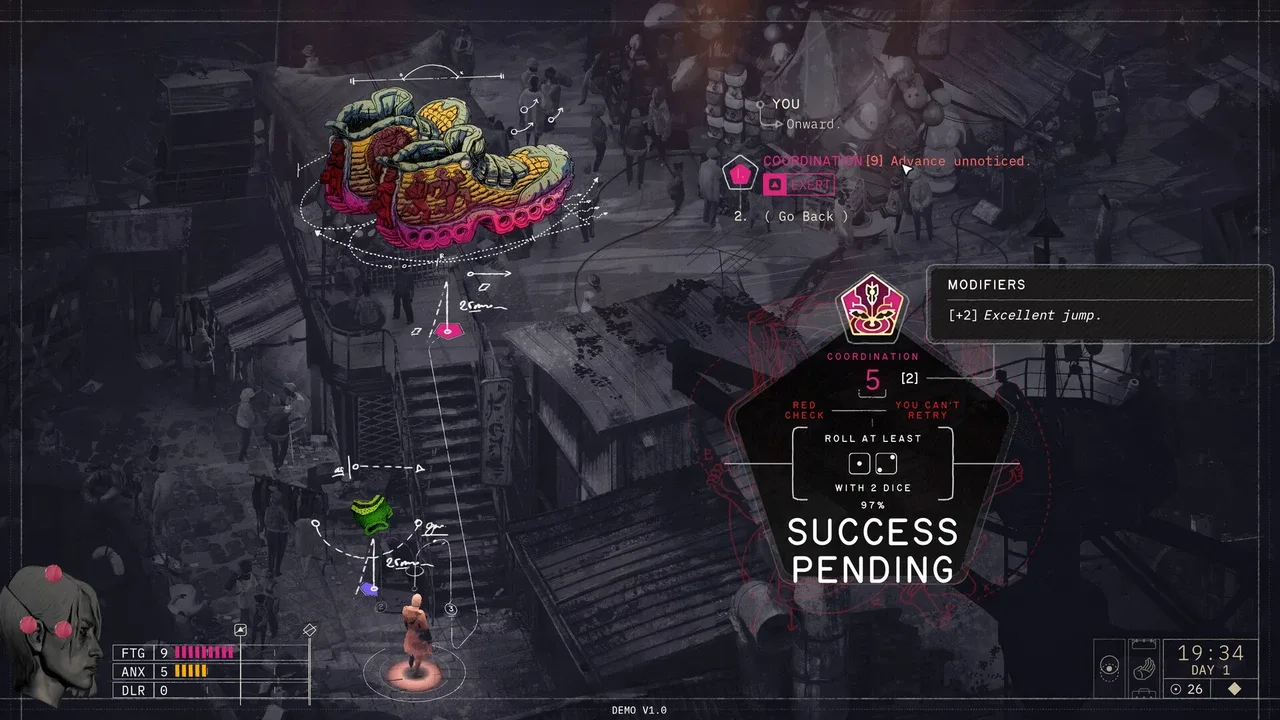
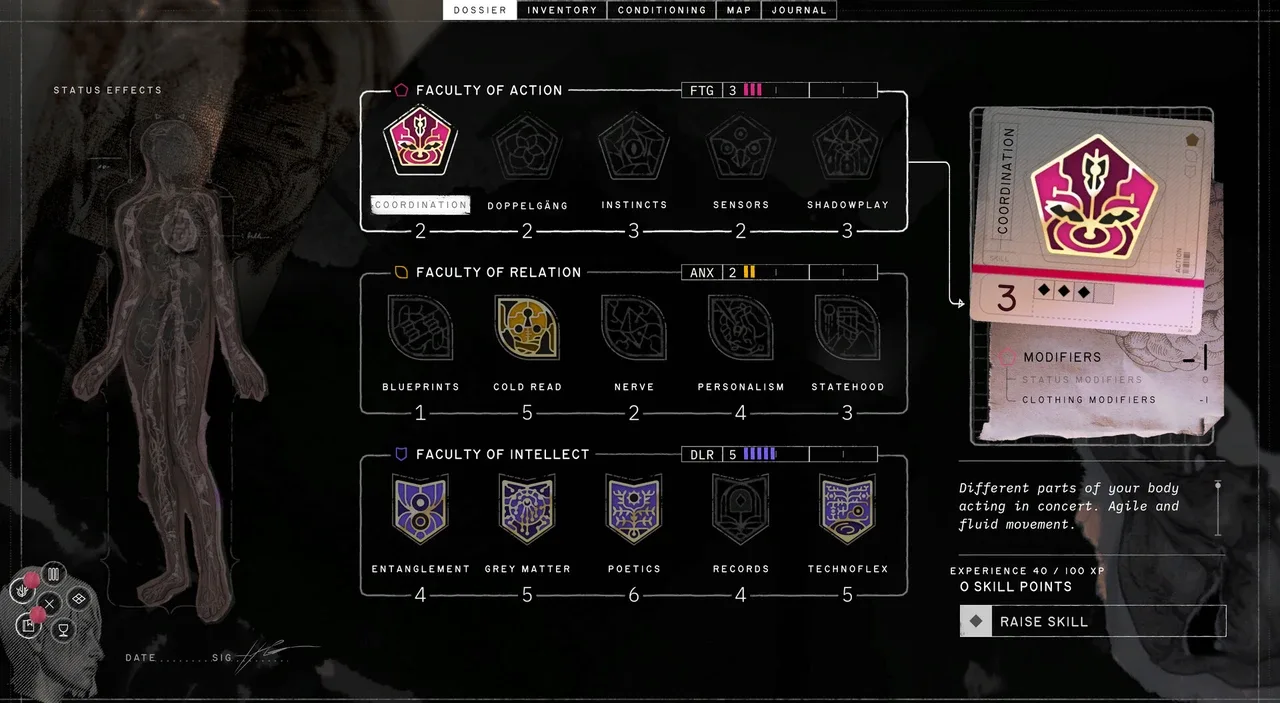
Zero Parades resolves all conflicts through a simple dice system: roll two of them, add relevant modifiers, and compare it against the intended result. At the start of the game you can increase and decrease different skills, each representing different aspects of your body, personality and mind. These range from more mundane ones like Coordination and Nerve, to the more bizarre Entanglement (how weird you are) or Statehood (how boisterously communist you are). These skills will offer up inner monologues during the course of the game, adding a bit more context to the conversations and skill checks, while also adding some personal flavour as your character’s conflicting perceptions of the world intermingle and talk over each other.
As you throw yourself into conversations and challenges, you’ll start to accrue Fatigue, Anxiety and Delirium. Accrue enough and you’ll eventually break, forcing you to permanently decrease one of your skills. These meters can be kept under control through indulging in vices like drugs and alcohol, but naturally they come with their own mechanical and narrative trade-offs too. This system also avoids one of the bigger traps that Disco Elysium fell into, where it was possible to sidestep similar consequences entirely if you were enough of a number-crunching goblin. Here, the meters are constantly ticking up. Regardless of how you try to play her, CASCADE at her core is a flawed, messy, and self-destructive person, and no amount of min-maxing can help you escape the gravity well of her dreadful personality – either in a mechanical or a narrative sense.
But one of the game’s most interesting mechanics is its Conditioning system. Over the course of the story, invasive thoughts about the state of the world and your personal history will bubble up. You can choose to reinforce these thoughts, locking them into your cognition. Not only do these provide passive bonuses to your skills, but they’ll also unlock new story beats and conversation options, with some even going as far to introduce new mechanics like turning non-diegetic systems into narrative considerations (read: fucking with your save files). What’s more, violating these conditions will stack negative effects too.
The system is an elegant reflection of the types of mental gymnastics a spy like CASCADE needs to perform to maintain their cover, and how it might rub against her own personal beliefs, and indeed yours too. Over the course of my game, I went from having a spy who was cool-headed and calculating, to being a highly empathetic wreck who was constantly apologising for the mistakes of her past, and it perfectly matched the arc I had for her in my head. Also, she would have a minor meltdown if anyone talked shit about Luzian pop music, which if you’ve met any K-pop fan, tracks.
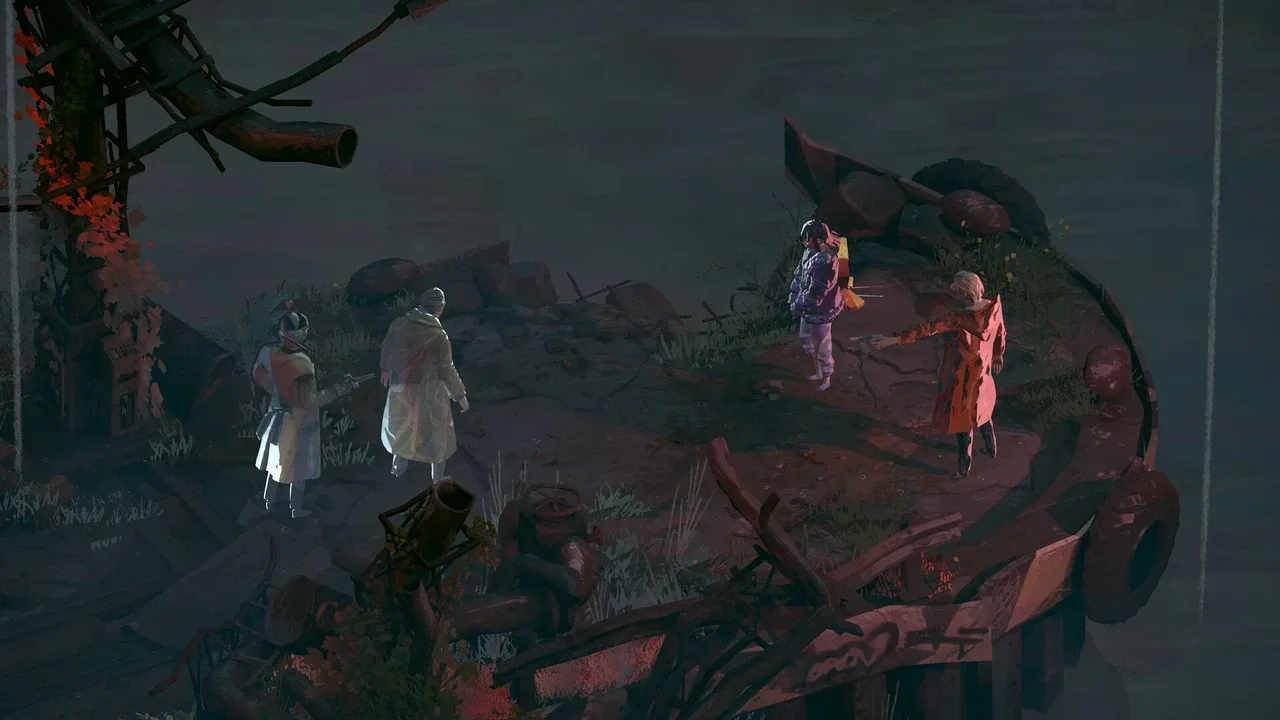
The game isn’t entirely without its problems though, and that extends to both presentation issues, but also matters of tone.
For as narratively dense as it is, it could have benefitted from another editing pass. Typos are frequent, and quite often there can be mismatches between written text and the spoken dialogue. Furthermore, some audio lines appear to be missing entirely or lack any post-processing on them. In one case, I stumbled upon a section where the narrator seemingly interrupted herself to have another go at a line read. At times the writing can also feel a bit self‑indulgent, becoming over-saturated with laboured metaphors. Despite all that though, the game’s never insincere about any of it; the writers are saying something with their whole chest, and I can’t fault them for that.
The game also creeps into something approaching orientalism when concerning the country of La Luz. Regardless of how Spanish-coded they’re made out to be or how they frame their exceptionalism through very American lenses, when the country’s main cultural exports are “L‑pop” and hyper-stylised cartoons, it’s hard not to draw those parallels. I understand how you arrive at that point given the very real and fraught history of media being used to sanitise countries’ more right-wing beliefs, but when you also feature characters who are fearful of the soft power that such cultural items represent – both for legitimate reasons and reactionary ones too – it can feel a bit awkward at times.
But none of those missteps ever fully compromised my time spent with Zero Parades. What stuck with me was its dense and expressive art, its supreme confidence in its prose, its layered and thoughtful systems, and the skilful blending of all those elements with such aplomb as to appear effortless.
Umberto Eco once said that any nation must constantly invent new enemies to test its values against, and when it runs out of enemies it must look inwards, upon which it will either find itself or find itself lacking. Zero Parades is a game that takes that idea and breaks it down to its most atomic element: individual people. How many little ego deaths are you prepared to suffer, when your entire self-worth is defined by a distant political ideology? And when the pendulum of history swings in the other direction and you’re finally forced to confront yourself, how can you do so when the only thing that has ever defined you is the presence of the Other?
Or to quote Luzian pop star Ultra Violeta, when the only thing that’s ever defined you is “you but from a dream”.
