

As a child, my fondness of the Percy Jackson novels led me to taking a keen interest in Greek mythology. Within said mythology, I was always fascinated by the character of Achilles. This guy was a fearsome commander, who was nearly indestructible and yet today, you only hear the name Achilles when it is used in conjunction with his prime weakness: that godforsaken heel.
Much like Achilles himself, Metroid Prime 4 is carrying a clear weakness: its hub world of Sol Valley. The bland layout and emptiness of this desert rings uncharacteristically hollow for a series known to feature rich, beautiful environments. If Metroid and Star Wars shared a universe, then the Rebels could have defeated the Empire by simply baiting them out to Sol Valley … this sight of endless sand would instantly send Darth Vader into a coma.
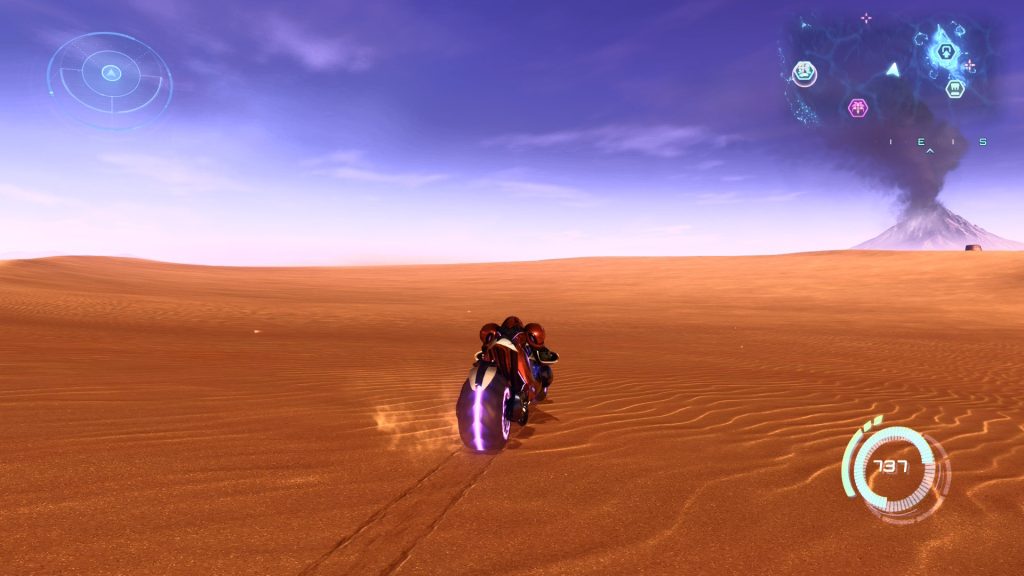
Within these vast stretches of desert lies batches of green crystals, federation debris and a handful of simplistic, albeit inoffensive puzzle shrines. There aren’t many notable enemies, locations, or challenges to be found in this overworld. Samus’ new bike Vi-O-La is relied upon to traverse this space, but the lack of ramps or varied terrain make riding through this area feel dull, so for the most part, you are just left speeding through this flat desert, wondering why it is even in the game. The latter is what really bothers me about this overworld’s inclusion, because as I will discuss shortly, it is not obstructive enough to make a dent in how great this game is, but its inclusion just feels totally unnecessary.
Even though the overworld is middlingly designed, Samus does not actually spend enough time in it to tangibly impact your experience. This is because you are encouraged to explore it after obtaining your bike, and once you do, you realise that the area is not that big at all and simply acts as a hub level, to connect the main dungeons together. Aside from one mandatory, frustrating collectible hunt late in the campaign, I don’t see players needing to spend a significant amount of time in this overworld, which reduces the impact of this questionable design choice on the overall experience. And speaking of the overall experience, does the rest of the game live up to the expectations for a new entry in a beloved franchise? Well …
Spectacularly Unique, Yet …
What struck me immediately about Metroid Prime 4 was how singular the game feels compared to its modern-day shooter brethren. So many of today’s shooters feel like an offshoot of either Doom (2016) or focus exclusively on multiplayer modes to capture as wide an audience as possible, then keep them trapped in some kind of hellish live service loop till the end of time. How many shooters have we seen with a cell-shaded art style, heroic mechanics like special powers or meters that fill up throughout the game? Oh, and let’s not forget the seasonal progression, loot boxes, or shiny weapon skins either.
Conversely, from its opening hour, Metroid Prime 4 establishes a level of quality game design that is rarely seen in this genre. The initial sequence on the research base is bombastic, tightly paced, and accompanied by thrilling orchestral music. The level takes you through a variety of spaces, from a sprawling entrance area into small corridors and courtyards with blazing firefights. The enemies are agile and wield an impressive array of attacks, requiring skilful movement to evade, often using Samus’ remarkably responsive lock-on dodging manoeuvre.
With this level, Retro Studios makes a statement that rings true for all of this entry’s primary locations: Not only are you getting Metroid Prime as you remember, but in an age where developers often forego tried and true for flashy and addictive, Beyond is setting out to provide a cornucopia of fundamentally strong but simple design choices, and by doing so, proving that nailing those fundamentals is all that is required to deliver an excellent gameplay experience.
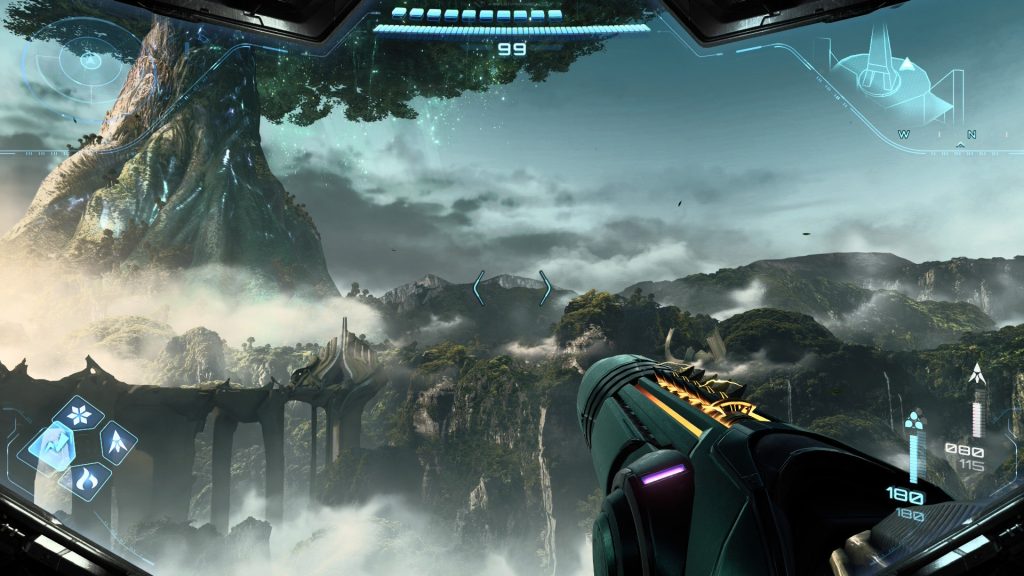
From the luscious jungles of Fury Green to the glacial terrain in the Ice Belt and more, Metroid Prime 4’s level design proves to be superb on all counts. The biome diversity is even more impressive when you consider just how much care has gone into the layouts of these individual sections. The natural serenity of Fury Green is accentuated by flying flocks of birds, a breathtaking background track combining the work of a choir and orchestra with rhythmic electronic tunes, and incredible vistas consisting of ancient structures and flora in the distance, broken up by fields of thick clouds. The resulting effect of these design choices is that the game feels immersive beyond belief. While playing these levels, I felt completely absorbed into the world, akin to watching a Villeneuve film like Blade Runner 2049 or Arrival, where the work of famed cinematographers coalesce with memorable scores to create an utterly transportive experience.
Notice how I compared its immersive pedigree to films and not another video game; that is because like previous Prime entries, the transportive quality found within Beyond is not present in many contemporary titles, and is very much a unique, signature quality of the Metroid franchise, facilitated by its considerable attention to detail in artwork, sound design and level structure.
Speaking of level design, Beyond excels in this department as well. These arenas feel less labyrinthian than previous Metroid games, but they do measuredly feature series hallmarks like backtracking and the use of save stations for checkpoints. What I liked most about its structure is how often Retro is willing to throw a spanner in the traditional flow of a level; for example, you might see a bridge in front of you and think, well I am meant to cross that bridge right? Not quite. And then after you have to turn back, instead of just going up some steps to a door, the game surprises you with a batch of new enemies, then sends you to a completely different part of the map to acquire an upgrade.
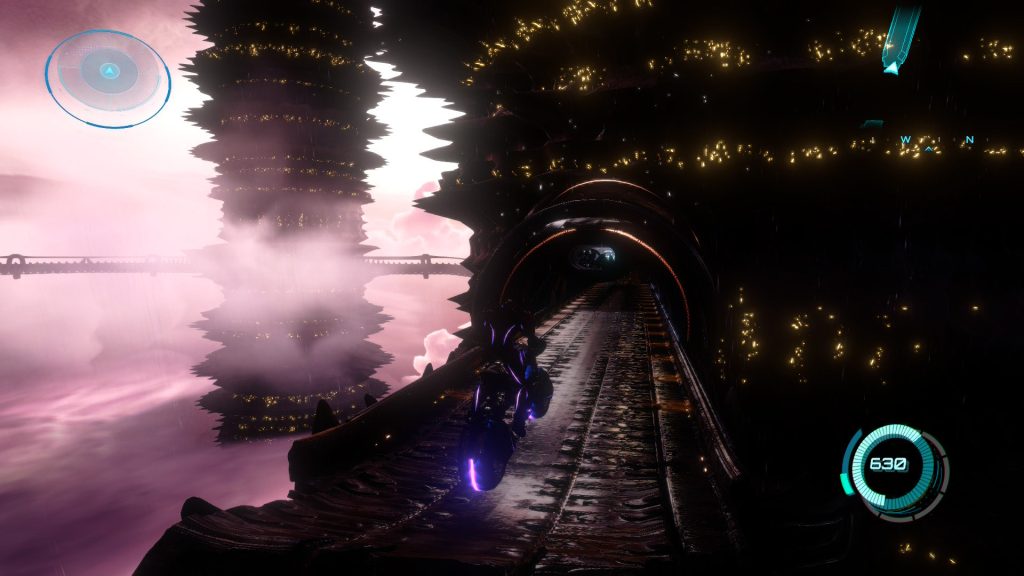
It’s these fluctuations in the otherwise traditional flow of exploration that heighten the sense of adventure, ensuring that the player is kept on their toes and not just going through the motions. Speaking of the adventure, Samus meets some companions during her time in Viewros and much discussion has occurred online regarding their inclusion in this game.
For my money, these NPCs are relatively inoffensive. Their dialogue is not memorable like what you would hear from supporting characters in a Bioshock title, but nowhere near as egregious as the lines delivered in a questionably written game like New Tales from the Borderlands. Myles Mckenzie, the character getting blasted for his ‘nerdy’ demeanor, is the most featured side character but most of his lines are harmless and often boil down to something as simple as giving Samus a general idea on where to go or how to obtain an item, which is frankly welcome in a game with a hefty amount of backtracking.
… Supremely Refined
It has been almost 18 years since the last numbered Metroid Prime title, yet playing Beyond, you would be forgiven for thinking this series has been refined over two decades with numerous entries like the Call of Duty franchise. The controls are super responsive, everything from the default sensitivity of the crosshairs to the tactile feedback when rolling around as a morph ball feels flawless.
Similarly, the lock-on aiming is well implemented in that it snaps to the enemy but does not guarantee a hit, as Samus’ beams are heavier projectiles than the bullets in a military FPS, and take longer to travel to the target, which means even if your crosshair is aimed exactly at them, there is no guarantee of a hit, unless you also take into account how and where that target is going to move. This forces the player to pay attention to the attack and movement patterns of the hostiles, while also preventing them to use the lock-on as a crutch to remove the game’s skill requirement. From an in-universe point of view, the lock-on almost justifies itself as a requirement for Samus, so she can counter the agility of her enemies, as they are far nimbler than the ones found in most contemporary shooters.
Make no mistake: The lock-on will not save you against the tougher bosses in this game. Without giving anything away, I was taken aback by how intense some of these fights were, as the bosses were extremely mobile (sometimes flying), or dealt brutal damage that would wipe huge chunks off the health bar, in addition to using area of effect attacks that would literally take up the entire FOV of the screen and require very specific movements in a set order to evade.
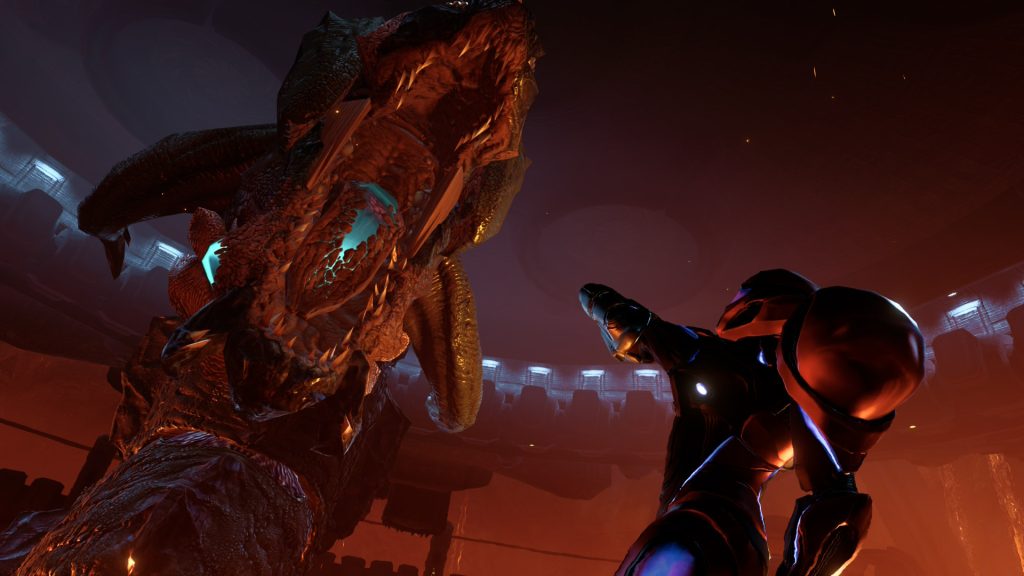
To give you an idea of how tough they were, I died more here than I did playing Doom: The Dark Ages on Ultra Violence difficulty, and most of my deaths in Beyond came from the bosses. My favourite of these bosses was the final one, which starts somewhat middlingly but escalates to an epic fight of literal galactic proportions. The swelling music, breakneck intermission set piece and remarkably sinister voice acting from the foe were all fantastic touches.
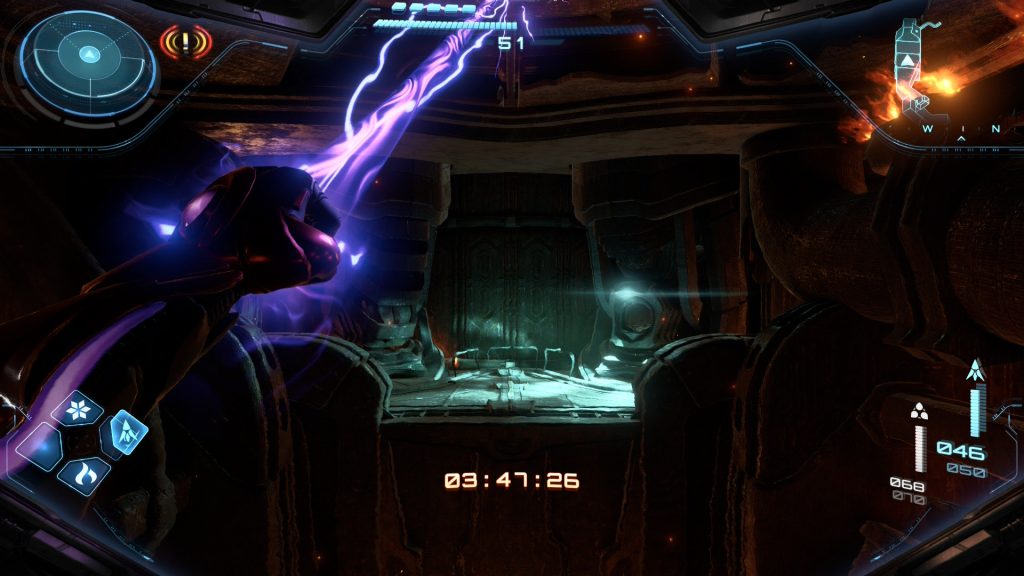
The other element of the gameplay loop that I really enjoyed were the new psychic abilities. Through the alien race of Lamorn, Samus is granted various psychic powers, ranging from telepathically guided beams, to grappling hooks and the ability to telekinetically move glowing purple balls, which believe me is more fun than it sounds. The enjoyment of these abilities is brought on by the Switch 2’s excellent HD Rumble. This rumble adds a tactile sensation to these abilities, as an example, the purple balls fizz in your hand, and you feel every ridge and bump when manoeuvring them along the surfaces of older shrines and rock surfaces. The grappling hook is also used thrillingly, especially during escape sequences, giving the player a real sense of momentum as Samus propels through these larger levels with kinetic glee.
What elevates these psychic abilities further is that you are required to use them. They are not just flashy powers that exist to distinguish Beyond in its marketing, they are carefully interwoven into the fabric of every boss fight and exploration segment, ensuring that their inclusion feels genuinely earned. There have been many games as of late that have introduced interesting abilities, but it becomes clear as you progress through them, that they are just there as an unlock for completing a level or for a flashy trailer shot in the marketing campaign, as they can be ignored for the majority of the experience and are just there… as an option.
If we were to use this year’s Death Stranding 2 as an example, I could probably pad out the rest of this review with names of weapons, abilities and even apparel that you can completely ignore and still obliterate every boss and challenging delivery, while getting S ranks for fun. In Metroid Prime 4, if you don’t utilise the countless psychic mechanics, the bosses will wipe you from the face of existence, but before then, you will likely be stuck in an alien cave wondering how to progress, because you didn’t pay attention during the introduction of Psychic Control Beam.
While the story here is not much to write home about, it thankfully takes a back seat for most of the experience, allowing the psychic mechanics, shooting, and environmental design to do the talking. As I mentioned earlier, the NPCs are featured sparingly, although this changes slightly during the third act, where they become more involved. Since beating the game, I have been reflecting on why these characters, who are not particularly well written, did not bother me as much as chatty sidekicks usually do in similar stories. And it comes down to one quality they all possess: Sincerity.
These characters, for better or worse, are mostly void of sarcasm, cynicism, and nihilism, even in the face of dire odds. And while that comes across somewhat unrealistic at first, it also ensures the story maintains a light, breezy texture, without getting bogged down by negativity or monotonous monologues. I also appreciated that these humans possess a deep respect for Samus. Some admire her as a combatant, while others, like the doting Private Nora Armstrong, are inspired by her legacy and abilities, which does a lot to convey the impact of a protagonist who rarely speaks at all.
Going forward though, I would like Retro Studios to either give Samus voiced lines, or cut back on the supporting characters, as I find it bizarre that she does not reply to anyone during these one-sided conversations. Erin Yvette, who did an excellent job voicing Blonde Blazer in Dispatch, records her grunts and screams, which Samus belts out whenever the player takes damage. It feels like a wasted opportunity to not give an actress with her talent actual dialogue, which would have reduced some of the awkwardness around the NPC interactions.
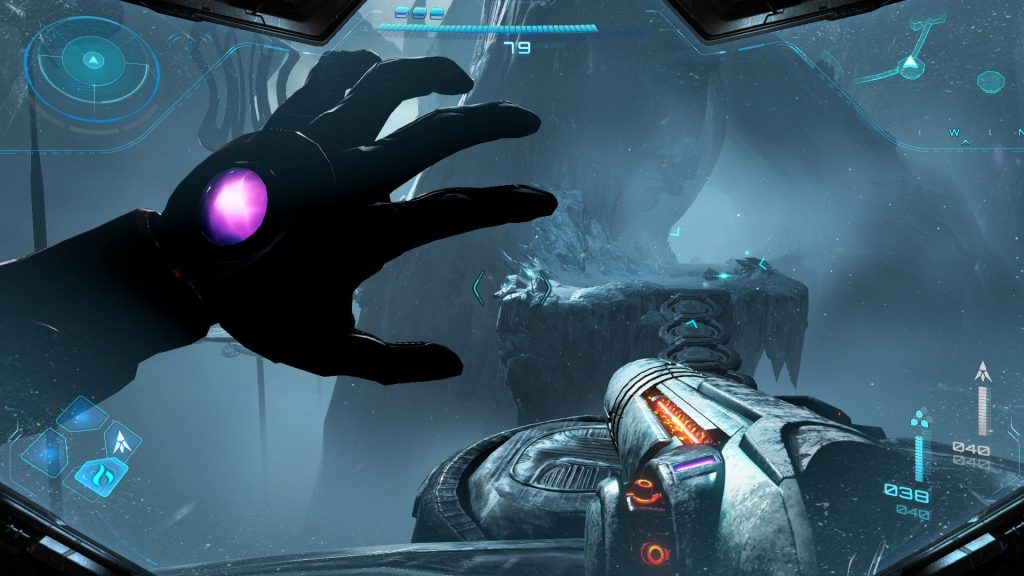
The final aspect of the story I want to touch on is the Lamorn. I found this alien race, responsible for Samus’ psychic powers and the current state of Viewros, to be quite interesting. Their story is only told through brief cutscenes in the main story, but when exploring the world, there are statues that deliver more of their backstory through flashbacks and dialogue. What I found compelling about them was how they were portrayed morally ambiguously, and their arc intriguingly explored the dangers of wanting to push scientific boundaries, specifically through genetic experimentation and uncontrolled environmental tampering. You rarely see topics like this discussed in popular media, and without spoilers, I give the writing team considerable credit for the way they have incorporated these ideas here, without coming off as preachy or heavy handed.
I have already discussed how impressive the environments and biomes look in Metroid Prime 4: Beyond and thanks to the power of the Switch 2, they are also presented at sharp resolutions in both docked and handheld modes. I switched back and forth consistently between portable and TV play, as well as the 60Hz Quality and 120Hz Performance modes, and did not notice any frame drops, whether out in the overworld of Sol Valley, or inside the game’s various arenas. The anti-aliasing used by Retro Studios here is clearly not Temporal AA, which also helps in the clarity department, as that technique tends to burden many contemporary releases with a blurrier appearance.
From a rendering standpoint, what stood out to me the most was the foliage, particularly in Fury Green. While the vegetation in Beyond is less lifelike than what you would typically find in a current generation release, there is enough detail and stability in their appearance that I prefer the way the trees, vines and leaves look here. The Volt Forge and Flare Pool arenas are also superbly lit, helped by one of the best HDR implementations I have ever seen in a video game. If you have a HDR compatible display, I recommend playing this docked in the 60FPS Quality mode, with the black and white levels properly tuned, as you will be in for a sensational visual feast.
Reviewed on Nintendo Switch 2 with a code provided by the publisher.
Its stunning environments, tightly tuned combat and kinetic psychic mechanics are offset slightly by an uncharacteristically bland overworld, but Metroid Prime 4: Beyond remains a work of supreme quality, and one of the best games of the year.
