

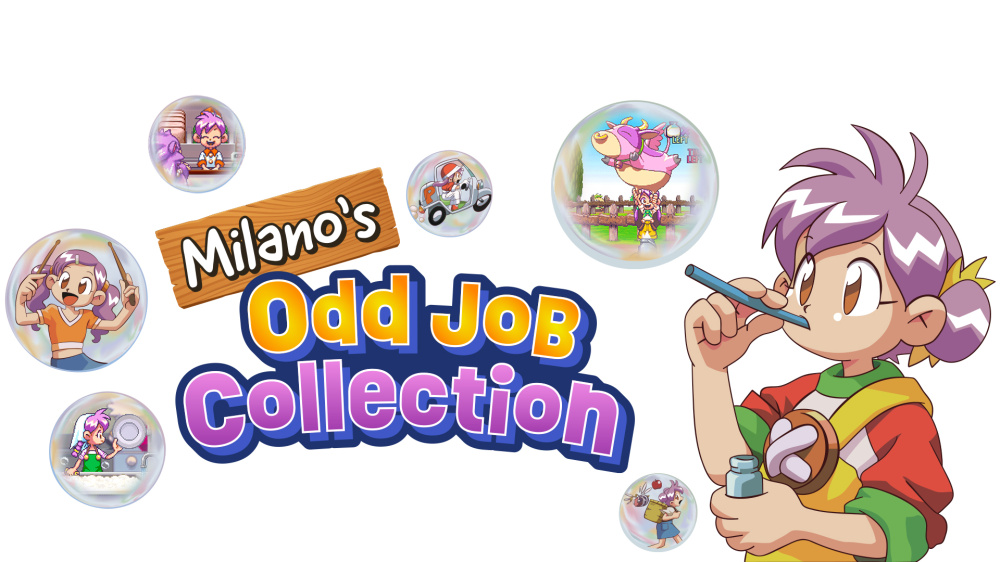
Now here’s a deep cut. In 1999, Westone Bit Entertainment—creators of Wonder Boy—released Milano’s Arbeit Collection for PlayStation. Quite the change from the studio’s usual arcade and RPG fare, this was a mini-game collection mixed with a life sim. Unsurprisingly, it never saw an international release at the time—a 2D minigame collection wasn’t something localisation studios wanted to take a gamble on at the end of the PlayStation’s life cycle. Twenty-six years later, this charming little game finally gets its due, landing globally on modern platforms under the title Milano’s Odd Job Collection.
The setup: 11-year-old Milano suddenly finds herself home alone for the summer. Her mum has to go to hospital, so she goes to stay with her uncle … only to get there and find that he’s away on vacation. Not an ideal situation—and this family really needs to step up to their care responsibilities, sheesh—but Milano decides to make the most of the circumstances and prove she can look after herself. That means taking on odd jobs around Zucchini Town to earn some money, while looking after her uncle’s home.
Those jobs take the form of minigames, from a match-three type dealio, to making cakes at a bakery to serving fast food in a sort of proto-Overcooked, to milking flying cows by chasing them around a farm and avoiding the other animals running rampant. There are eight games in total, each wildly different but with a common theme of being mechanically simple and easy to pick up while having enough layers to make the harder levels a decent, often chaotic challenge. It’s the playful design of Mario Party but for a solo player, and with more arcade influence.
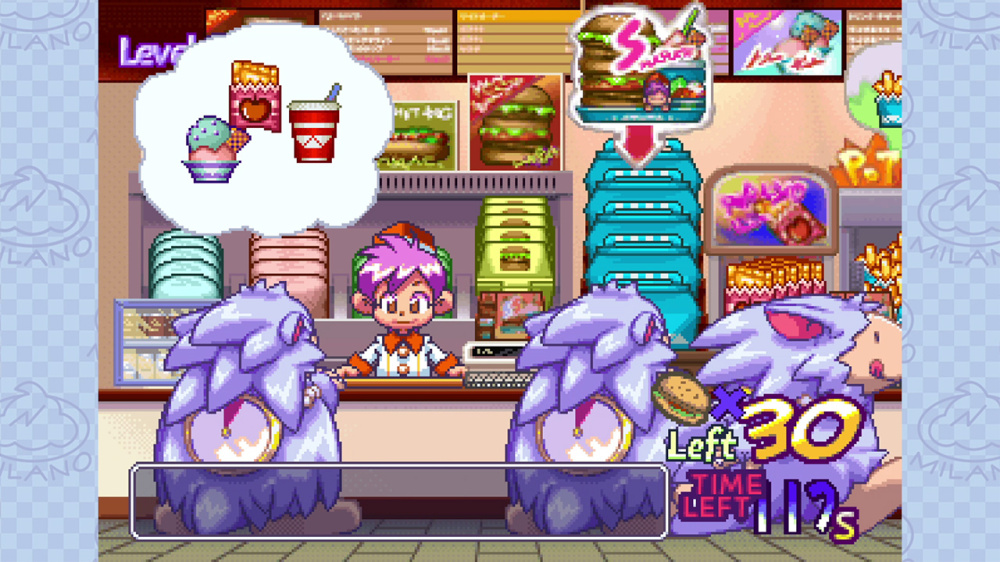
Each in-game day, you can pick one such game to play, earning money based on how well you do. The specific jobs available on a given day depend on various factors, like the weather, the day of the week, and Milano’s stats (more on that in a sec), but there’ll always be at least one job available. And if you don’t want to work, you can always just hang out at the park or spend the day redecorating the house—though you won’t earn any money that way, of course.
When the shift’s over, it’s time to do chores and/or relax. A variety of household activities are available— cleaning, laundry, cooking, watching TV, playing video games, and so on—and you get to choose two each evening. These aren’t minigames, but they each show a cute little animation of Milano doing the chosen task, and most come with a chance to increase one of three stats: energy, mood, and skill. Thankfully, there’s no penalty for not picking certain things; Milano won’t starve even if you never cook, it’s really just about what you want to do and what stats you want to raise.
The stats themselves are simple: mood increases the time you have for each job shift, energy unlocks new jobs at certain thresholds, and skill opens up higher difficulty levels with more potential payout. They’re all easy enough to raise, and it doesn’t take too much effort to max them all out—there’s no need for any sort of heavy stat management here, it’s really just a way of adding a light mechanical touch to laid back life sim side of things.

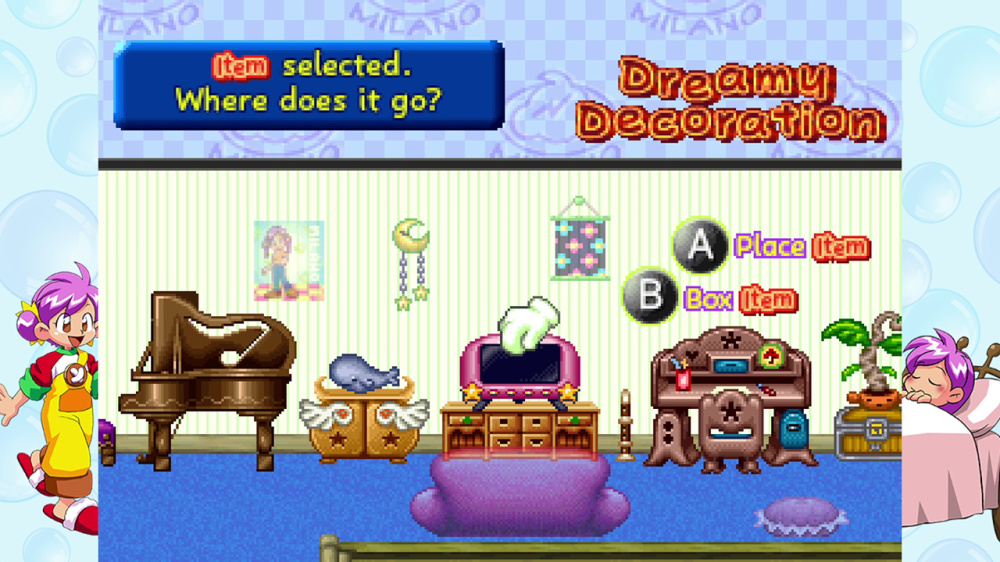
As far as all that money you earn, it all gets poured into buying furniture and other household items from a shopping catalogue. Some of these purchases unlock new activities for Milano’s evenings—you can’t watch TV until you buy a TV, for example, and old Uncle Unreliable doesn’t have much of anything to start with—but they’re mostly just there for the fun of decorating. There’s a lot of stuff to buy, enough that you’ll never buy it all in a single playthrough, but that’s part of what makes browsing the catalogue and choosing what to order enjoyable.
And so it goes, over the 40 days and nights that make up Milano’s summer holiday: work during the day to earn money by playing minigames, do chores and activities at home to raise stats (or just chill), and spend your cash on homewares for decorating. Once it’s all over you get a letter grade based on your performance, and while I guess you could go all out to optimise your routine for the highest grade possible, that’s not really what Milano’s Odd Job Collection is about. The 40-day time limit and income-shopping loop add a little bit of structure and some short-term goals, but this is really just a game about chilling out with some fun, silly mini-games—and the collection hits just the right spot with those.
The other thing that stands out is how much effort has gone into bringing what was a Japan-only PlayStation classic to a global audience. Marvelous and XSEED pulled out all the stops with the localisation, complete with excellent English voice acting and an English script that effortlessly navigates the quagmire that is translating puns and jokes. Despite being a PlayStation game originally, and presumably running through an emulation layer (rather than being a direct port), Switch controller symbols are woven into the game—and not just in text boxes and menus, but even when they’re built right into the game proper, as they are with a rhythm minigame.
These may seem like little things, but they’re the things that make or break a project like this. Milano’s Odd Job Collection is the kind of quirky, funny game that could easily lose its charm through a slapped-together translation and porting effort. Instead, the playful atmosphere and sense of humour of the Japanese original come through brilliantly in this localised version.
That makes this an easy recommendation for anyone who likes retro oddities. By its very nature, Milano’s Odd Job Collection won’t be a game for everyone. It might not even be for most people. But for those who like digging deep into the bucket of classic games that never made it out of Japan when first released, this is a rare treat—and one made all that much sweeter for the love that’s gone into its long-overdue worldwide debut.
Version tested: Nintendo Switch
Review code provided by the publisher
