


It’s baffling how good a game Fire Emblem Fortune’s Weave is. Because it really shouldn’t work.
Intelligent Systems has used the recipe that made Three Houses such a memorable entry but tripled the proportions of each ingredient. Whereas the former’s blend of social worldbuilding and tactical combat made for a succulent meal, Fortune’s Weave is a proper feast. It has more memorable characters, a grander storyline, deeper social interactions, and an evolved tactical combat system that is as addictive as it is intricate.
By increasing the scope of the project this dramatically, you would think that the game is thrown off balance or loses a touch of what made three houses so special. But not only does this game work, it perpetually feeds off its own gargantuan scale to deliver a truly spectacular experience.
Grids and Ladders
The combat in Fortune’s Weave is so incredibly nuanced, you could probably write an essay dissecting it for a game design course and still not cover all its intricacies.
Let’s talk about movement and placement.
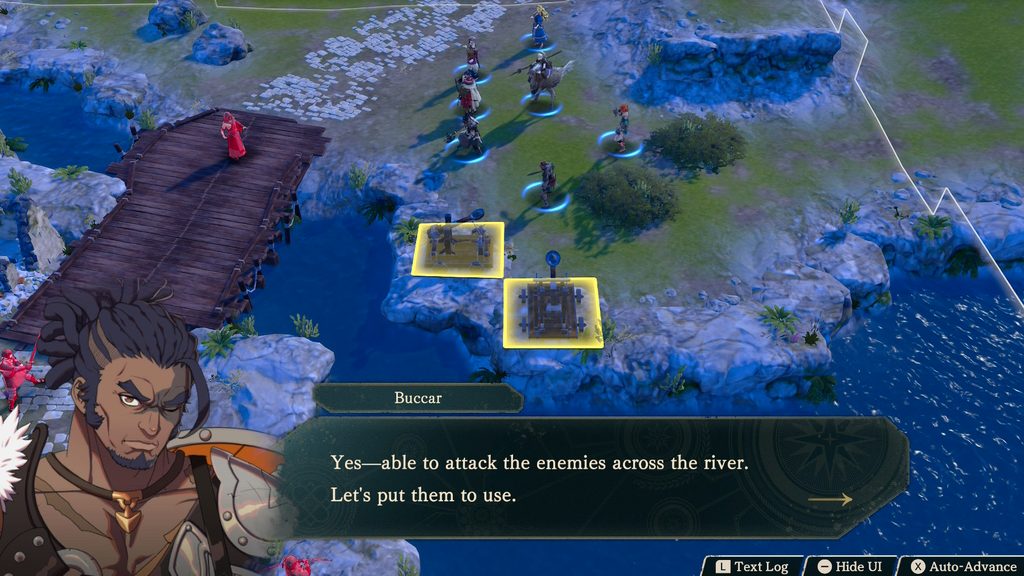
Like you would expect, units have unique statistics that you allow them to traverse the grid at their own pace. A mounted unit on a horse can move further per turn than a heavy unit for example. But the game constantly keeps you on your toes by varying the nature of individual grid squares. Bushes buff evasion, fog squares blind the squad until the end of your turn and mini bosses will unleash attacks that cover 4-5 squares at a time, making your squad’s fronton rush look rather foolish.
Human enemies are smart. They will hide in bushes to buff their evasion or send weaker commoner enemies as bait to draw you forward into disadvantageous positions. Wild animals hunt in packs and pick off individual members, typically my magic units with lower defence stats. Bears won’t just attack you with claws, but throws boulders at your archers and sorcerers, so good luck trying to pick them off from a distance. Then you got these mummies with ridiculously strong magic abilities, who are also here for some reason and have a real bone to pick with the fauna.
Which reminds me… there are multiple encounters where you can join pre-existing battles. Two factions will be going at it, and then here you are, joining in like the uninvited uncle pulling up to a Christmas party in the midst of a huge argument. These multi-faction wars add to the game’s unprecedented scale. Then there’s the way the coliseum setting injects fresh mechanics into each fight.
On Leda’s path, the first qualifier held on the coliseum grounds introduced a Pure Water” buff applied by specific machines in the arena, with each machine needing to be manually toggled by your team before any meaningful damage can be done to the enemy armored units. Fortune’s Weave continually layers on new mechanics, to the point where you wonder whether your hypothetical, tactical gameplay chalice is at risk of overflowing. Luckily, the game allows for a breather after each chapter closing encounter by allowing you to free roam its enormous map for varying amounts of turns. This also assists with the pacing and ensures you don’t get burnt out having to clear huge battles back-to-back with no rest periods.
On top of that, the classic difficulty also keeps the series trademark Permadeath feature, which means if you do lose one of these units in the game, they can no longer be used in future battles, adding a whole other level of tension to each battle. Fortune’s Weave does provide a time travel ability, known as a Blessing, which allows you to revert to a previous turn if doom befalls one of your units. But this is not a free lunch.
Intelligent systems has completely removed save loading from the game. You only get one slot and it gets overwritten with autosaves constantly, which forces you to use that ability because if a unit falls, you can’t just load a previous save. Outside of battle, the time travel also ties into the game’s four paths, allowing you to freely explore the other heroes’ stories from a hub level, regardless of which path you choose to start with.
Let’s go through a battle scenario, so you can see how all these mechanics come together to add meaningful depth to the experience.
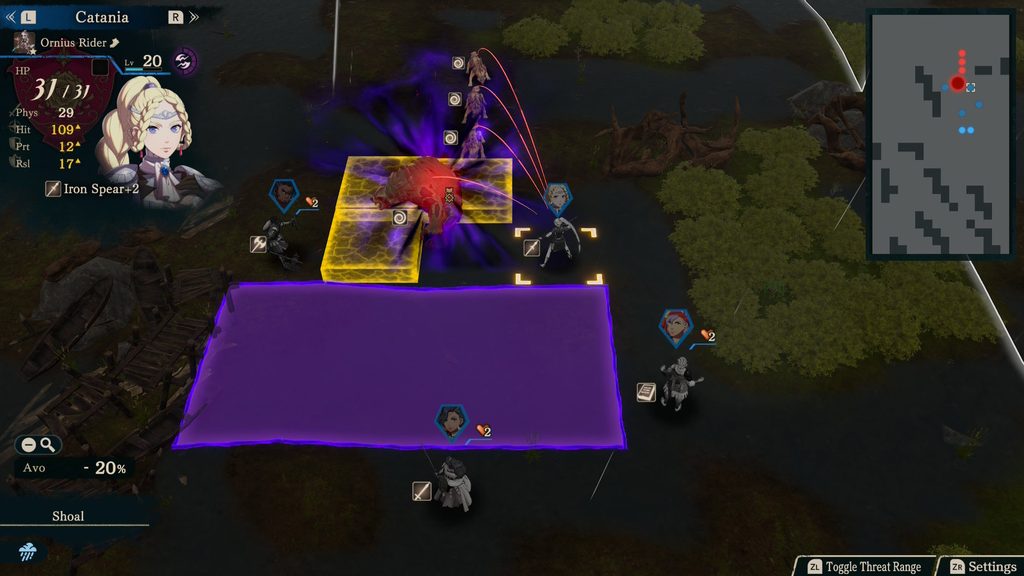
So here is Leda’s squad fighting two packs of animals. The bear is charging up an unavoidable attack, marked by the & purple squares in front of it. The yellow squares on the bear itself represent its barrier, which temporarily remove its ability to counteract when breached. You can see the front-right barrier has already been breached. Because of the unavoidable attack, I have been forced to send my main offensive units, Buccar, on the left of the bear, and Catania, on the right, ahead of the rest of my squad, temporarily separating them from my magic wielding members who can heal them, adding tension to the battle.
Catania, who is currently selected, is an Ornius Rider, which means she has a high Avoidance (Avo) stat which allows her to evade attacks and also move further than other allies, due to her being a mounted unit. But because it is raining, I have her dismounted from her Ornius, which has limited movement capability in poor weather conditions. Her being on-foot reduces her speed stat, which is not great because it’s harder for her to retreat from precarious positions. And if you look at how many beasts can target her, marked by the red lines leading to her from behind the bear, this is one of those precarious positions.
From that example, you can see how the game uses enemy attack types, unit traits and even the weather, to challenge the player, forcing them to reconsider their movement patterns, offensive strategies and the placement of their team, as well as encourage them to take risks, even if that means putting units in unfavourable positions to quickly end the fight.
Every unit. Every grid square. Even the arenas themselves, boast traits that make each combat encounter feel wholly unique in a game that spans many, many hours. It took me 15 hours just to reach Chapter 7 of the first act, with one hero’s storyline, before I took a detour to explore the others. And there are four heroes to choose from, each with their own ensemble of characters and unique plotlines to follow.
Destines Intertwine
Four ensembles. Four distinct plotlines.
Time travel. A Coliseum.
Bears. Mummies. Battlestar Galactica.
Fortune’s Weave has the most audacious story I have seen in a role-playing game.
The overall story revolves around the Heroic Games, a large tournament held in the Capital of Dagda. Each of our four heroes are uniquely motivated to participate in the tourney, given its grand nature draws large crowds into the city. And let’s just say all of these characters have varying levels of unfinished business with the people of Dagda. Then again… some are just psychotic and looking for an excuse to let their blades loose.
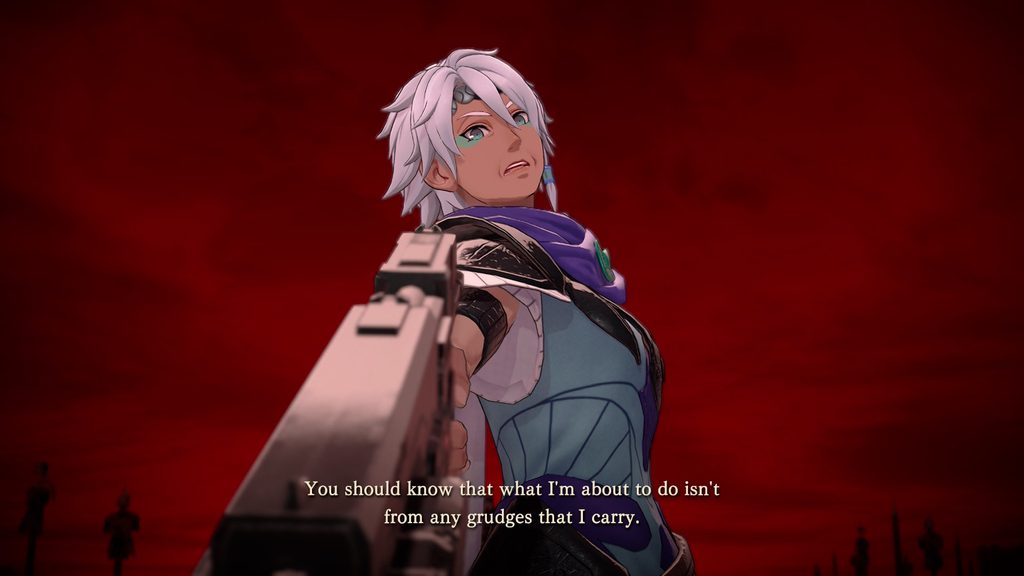
I started off with Leda’s path and was immediately taken aback by how ruthless she was. In the opening hours, this travelling dancer is going on a rampage, hunting down and killing anyone who was involved in the downfall of her family. I was slightly worried that she would be a one-note, vengeance driven psycho, but as the story developed, I was taken aback by the depth added to her arc and the way it subverted your expectations of a standard revenge tale.
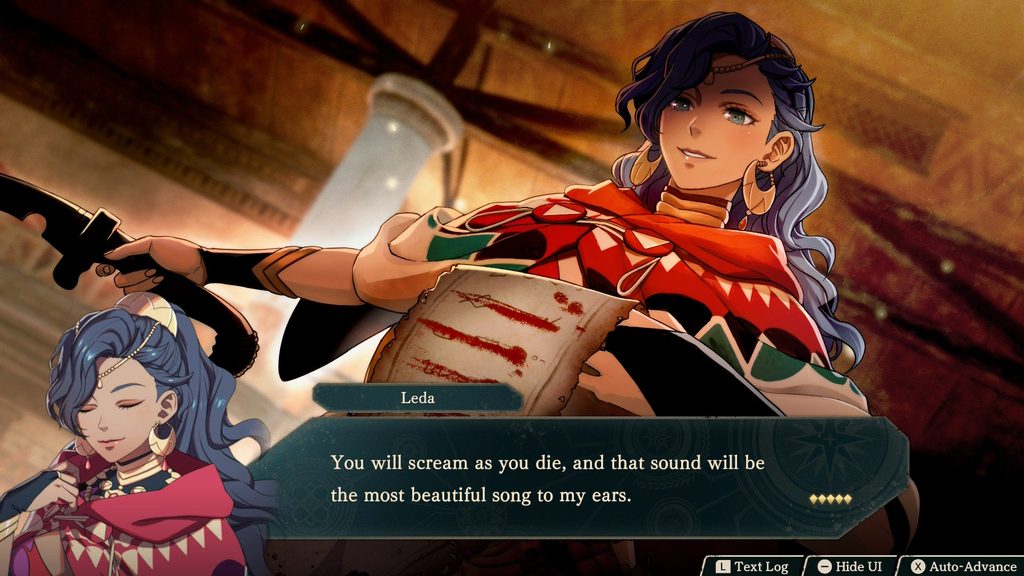
Leda’s path does a great job of exploring how the desire for revenge can twist someone, and how a life driven by vengeance can rob someone of their agency and free will. It is a really nuanced exploration of the concept, and the game is able to tell this story by contrasting her with other characters like Sirocco, a free-willed bard, who is less invested in her quest and spends his time flirting with every NPC he comes across.
Similarly, her guardian Bucca, while supportive, laments what her quest has cost them and sometimes appears disillusioned with Leda’s bloodthirsty ambitions. Not only are these interactions interesting, but the accompanying voice acting is terrific, and the dialogue is surprisingly strong, considering there were similar aspects of Edelgard’s storyline in Three Houses that were handled less delicately.
Speaking of Three Houses, the returning characters from that title were a blast to spend time with. I do not want to give away too much because the game hides these characters for a decent chunk of the narrative, but suffice to say, it reminds you how memorable that cast was. This is largely a new story though, so fans of the previous should expect fun nods as opposed to major callbacks.
What impressed me the most about how Fortune’s Weave handled its story was how they intertwined. while each hero gets a distinct storyline, their paths also cross in fascinating ways.
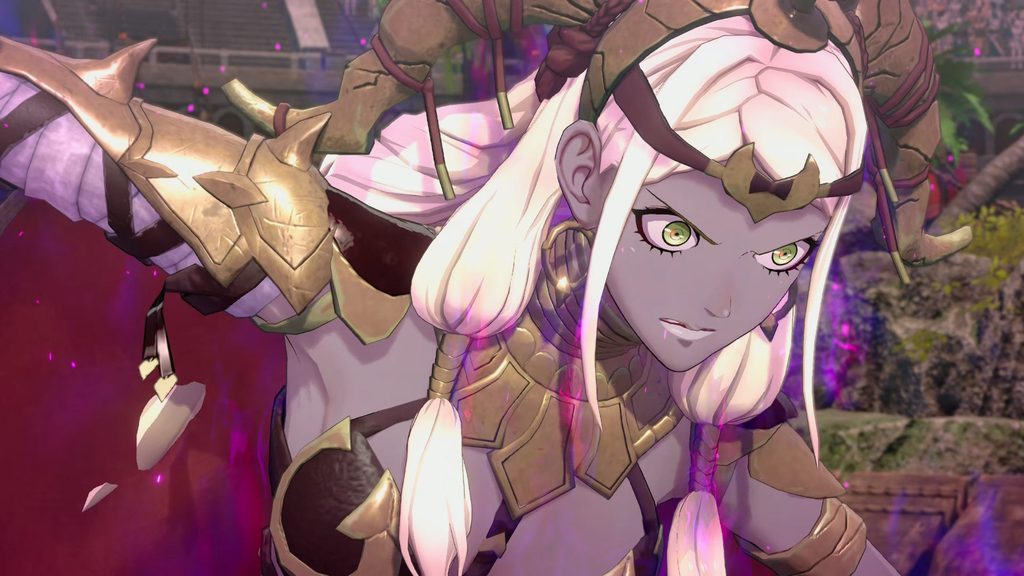
While playing as Leda, her squad comes across Dietrich and Theodora, two of the other playable heroes, and the characters get to have interesting conversations that shed light on their unique journeys to the Heroic Games. At the same time, you can also tell they are hiding aspects of their personality, which makes you want to play through their path to see their perspective.
This encouraged me to start going through Theodora’s path, which highlighted just how well the cross-storyline event that I came across in Leda’s path was written. Specifically, the subtle clues that hinted to her deeper afflictions. I also love that when these characters meet, they present an idealised, more sanitised version of themselves. Leda within her own crew will openly discuss her bloodthirst and struggles with the family legacy, but she is all smiles when meeting the other heroes. Seeing this further encourages players to explore the other paths to figure out whether they are also being cryptic with their true intentions and personalities.
Writers often don’t consider that subtle bit of deception we tend to pull off when meeting others for the first time, whether unconsciously or not, we present the best version of ourselves to try and win them over, before inevitably revealing the trickier parts of our personas when we feel more comfortable. Or is that just me? Well it can’t be, because these virtual characters do it too.
Point is, that is why these interactions feel so organic, you get the feeling that everyone in Dagda has their own agenda and is hiding their intentions, even if their intentions are not necessarily malicious. Some villains will still monologue and be transparent with their motives, but the characters within your squad that hide their backgrounds are typically the most entertaining to spend time with.
The scale of the narrative is ridiculous. You essentially get four full-length stories, because they are so dissimilar from each other. This is not like playing Resident Evil 2, with Claire and Leon having pretty similar journeys through the RPD with a few differing sections and bosses. These are wholly separate tales, each with their own sets of characters, particularly in the first act.
The game also manages to intertwine them in intriguing ways, contrasting Theodora’s royal status with Leda’s travelling performer lifestyle for example. This is even reflected in the exploration. That enormous map I mentioned earlier? Its not just big for the sake of it, it allows for explorable dungeons and city areas where Leda can perform as a dancer to earn money, and further upgrade both her squad’s equipment and their renown within the realm, which opens up opportunities to recruit new characters.
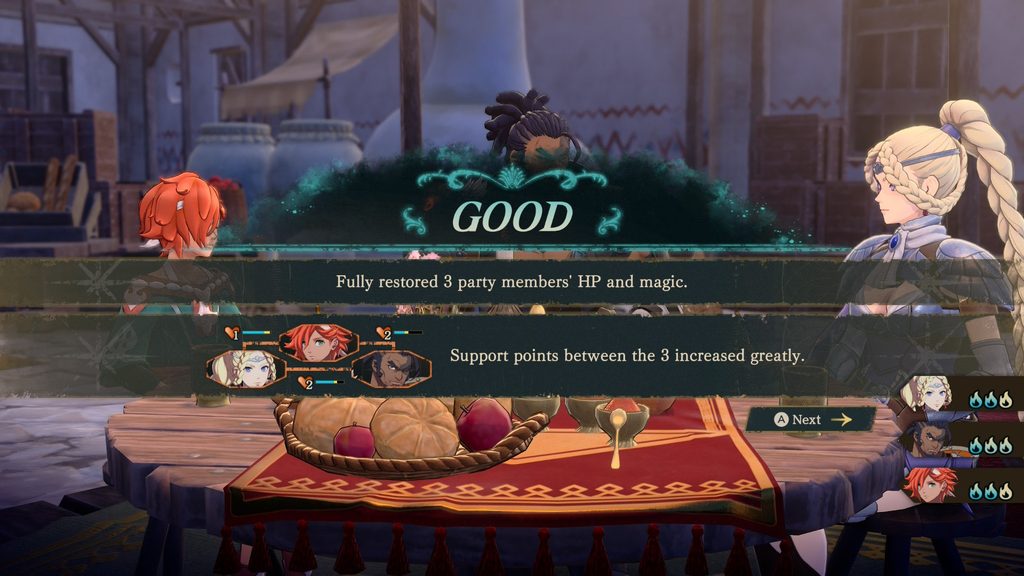
Another design choice that blew me away was how integrated the social mechanics are into the general gameplay. When your characters take action in combat and are situated near each other, they get support points throughout the fight. This also extends to when they train together to increase any of their skills, and when they share meals. What is impressive here is you are not taking these actions to increase your bond with the ensemble, eating meals together sounds like something a player would do for that reason, but in reality, I was primarily engaging with that mechanic to increase the amount of training my squad could do, which helps with the units’ stats in combat.
I like that you don’t have to go out of your way to increase affinity, and the game recognises that bonds will increase organically amongst squad mates by performing regular activities like fighting, training and eating together. Makes the entire social system feel less like a chore and allows it to fit neatly into the existing combat and exploration loop.
The Social Link system also blew me away, because the companions have support conversations amongst themselves, not just with the protagonist of each path. In many party-based RPGs, once the protagonist has built up enough affinity with a particular character, they will get invited to a conversation with them, where they get to bond and perhaps discover more about that party member. This game has that system, but with 4 separate protagonists and their own respective ensembles, but the individual ensembles also have social links amongst each other, not just with the main character of that path. Leda for example, has support conversations with squad mate Olympia. But Olympia also has those with Sirocco, who has separate ones with Mu.
This means there are dozens of these confidant events, and every single one I have come across has been entertaining, voice acted extremely well and revealed that wee bit more about the characters themselves. Never once have they felt like filler, which I was worried about after discovering how many of these there were.
More is More
Fire Emblem: Fortune’s Weave should not exist or work. I have discussed how excellent the tactics combat is and then the absurdity of a four-in-one narrative, stories that somehow work both individually and when they intersect. And then there is time travel, gods and a gladiatorial coliseum.
It is ludicrous. The kind of game that would be laughed out of a pitch meeting, because the sheer idea of it is so ambitious, you would not been forgiven for thinking it cannot possibly be pulled off.
You should see the cracks, perhaps with a hero having an underdeveloped plot or a tactics mechanic falling short. But as you keep playing, you realise they pulled off the impossible; they executed this perfectly. The battles don’t get stale because of how the enemies, weather, terrain and unique conditions are mixed up in each fight. The four plotlines are so different, in their own ways. The characters that need to be loveable are. The characters you need to despise? Believe me: you are going to hate them.
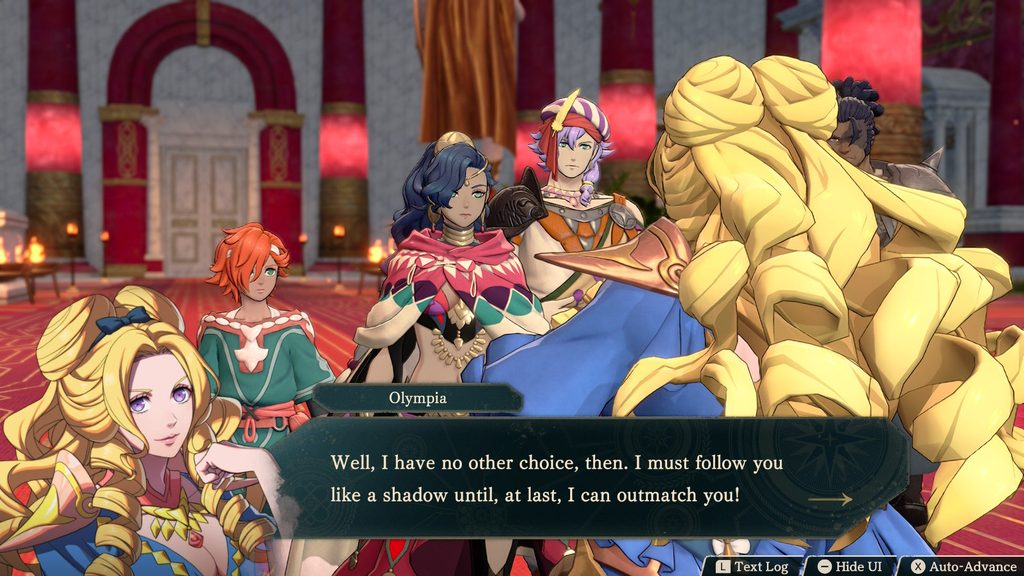
Most of my time was spent on Leda’s path, so I have a fondness for characters like her longtime rival Olympia, who is incredibly likeable as a capable magic wielder who just isn’t quite able to match Leda in combat. Which bugs her endlessly. But then, when I switch to Theodora’s path and meet Tobias, a goof who sleeps on the job, I like that guy too! There are no weak links here. I could go through every individual path and pick out characters I like, write a 2 hour long piece about how each dynamic brings something new out of our main heroes, like Olympia being a reminder of Leda’s childhood and constant need to be a capable soldier to fulfill her vengeance.
But at the end of that last paragraph, I started considering how I should continue this review.
Because the truth is, there is really nothing left to say. Not because there aren’t more mechanics, character dynamics or fun plot points to discuss. But because, all you need to know is, despite its absurd premise and scale…
Fortune’s Weave always works. And it shouldn’t. That’s the point.
No matter which path you take, how you approach the battles, which party members you choose to build affinity with or how you choose to spend your time between main story battles, you will have a great time.
And that is why this game is extraordinary.
Fortune’s Weave takes a remarkably maximalist approach to its design that shouldn’t work. The tactics combat impresses with unique movement, terrain and grid properties that elevate it beyond previous entries. While its four, interconnecting narratives are an achievement in both scale and execution, its social systems also take a leap beyond the relatively simple affinity systems that are common in other party based RPGS, by diving deeper into its memorable ensemble(s).
It is nothing short of a Masterpiece.
