
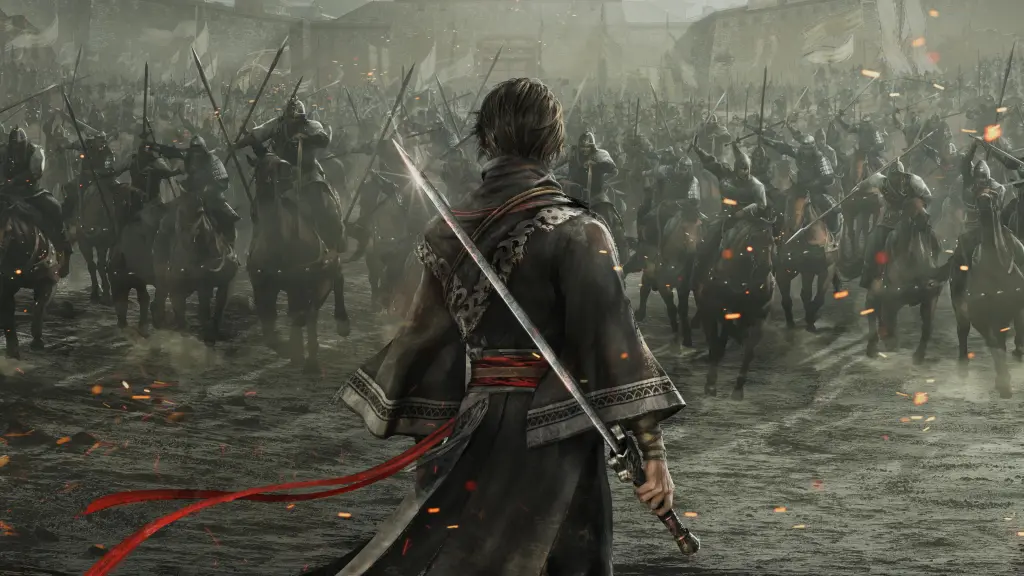
One of the many things that impressed me about the PlayStation 5 version of Dynasty Warriors: Origins last year was the technical accomplishment. Here’s a series that’s spent 25 years chasing the fantasy of being a general in the chaos of epic, 10,000-a-side battles. With the power of current consoles, Origins made those staggering numbers a reality (along with some clever new mechanics designed around such large combat forces). That made the announcement of a Nintendo Switch 2 port raise a few questions: could this comparatively weaker hybrid console keep one of the defining characteristics of Origins intact?
The short answer: yes, it does. The longer answer is that there are a few minor compromises to get there, but the Switch 2 version of Origins still does an impressive job of retaining the scale of battles in this Dynasty Warriors reboot, even in handheld mode. Portable Musou sure has come a long way from the PSP days …
First, the caveats. Origins on Switch 2 does have slightly graphical detail—not all that noticeable in the heat of battle, but you’ll see it in cutscenes, especially in close-ups of faces. It doesn’t look bad by any stretch, but it’s a port of a very visually impressive game to less powerful hardware than it was originally designed for, and you’ll notice it if you’ve played the PS5 or Xbox release.

The other—more controversial in some corners—compromise is frame rate. Origins runs at a stable 30 FPS on Switch 2, rather than the 60 that the game can easily achieve on other platforms. And as much as some folks like to claim that anything below 60 is unplayable, that’s far from the case here. There’s nothing in Origins that demands the kind of precision where a higher frame rate makes any practical difference, and the 30 FPS looks just fine in motion. If you do want a bit more, there’s the option of an uncapped variable frame rate that can get you higher FPS at the cost of consistency. This is what I’ve used for most of my time with the Switch 2 port, and I haven’t had any major issues of slowdown or stuttering. Both modes work just fine, and it’s really going to come down to personal preference.
These are very easy compromises to accept for a technically-impressive game that has, by and large, made the transition to Switch 2 extremely smoothly. It’s well optimised—something that’s often a struggle for third-party ports to Nintendo’s handhelds—and a lot of thought has gone into where performance savings will have the least impact. Dynasty Warriors is always a good fit for a handheld, and the Switch 2 version of Origins is about as good a port as you could hope for.
And if there was ever a game that deserved such a good port, it’s Dynasty Warriors: Origins. A reboot of sorts, Origins is Omega Force’s way of exploring a whole bunch of fresh ideas and new directions for Dynasty Warriors without that weight of expectation that comes with a numbered release. It’s still the same one-versus-1000 action at its core, but with a whole host of new mechanics and refinements that come together to create one of the most exciting and ambitious takes on the genre to date.
(If you want a more detailed assessment of Origins‘ new features, see my review of the PS5 version.)

The huge numbers of combatants I was talking about earlier aren’t just for spectacle; they’re a key factor in many of Origins’ new strategic elements. Squad manoeuvres can make even the weakest enemy footsoldiers into a threat, while your own equivalent becomes a very useful way of getting the jump on an unsuspecting officer or using the terrain to your advantage. The increased headcount makes awareness of the state of the battlefield and where the enemy is focusing its attacks—a key aspect of the “action strategy” part of Dynasty Warriors since the very beginning—more vital than ever. Large Forces see thousands of soldiers, enemy and ally alike, gain a big morale boost and access to new tactics, while shifting your objectives as a player slightly to disbanding the force (through a variety of means) rather than simply zeroing in on officers. Clashes between large forces are some of the most exciting, impressive moments in the whole game.
At the smaller end of the scale, one-on-one fights with other legendary officers are more dynamic and fluid now, taking a lot of cues from modern action games. Parries, dodges, resource management for active skills, and clever use of different special attacks all create a more intricate style of hand to hand combat than previous games, especially on higher difficulties.
Origins other big change is in its approach to storytelling. Previous Dynasty Warriors games were all campaign-driven, letting you witness the story of Romance of the Three Kingdoms through the eyes of key figures from each of its main factions in separate campaigns. Origins, instead, aims for a more unified approach through a silent player-insert character: as an amnesiac wanderer with mysterious powers, you’ll play through the events leading up to the formation of the three kingdoms in a linear fashion—getting to know the rulers-to-be along the way—before choosing allegiances in the latter half of the game.

Compared to the more splintered approach of earlier games, Origins manages a much more cohesive retelling of Three Kingdoms and allows much more investment in its heroes before swearing fealty to any one of them. It’s a very effective approach, albeit with the caveat of no large roster of unlockable characters. You are the Wanderer and that is solely who you play as, aside from brief moments when you can temporarily switch control to one of the more familiar Three Kingdoms heroes as a form of power up. The single protagonist approach works well for narrative effect, but not having an option of taking those iconic characters into battle—at least in a free play mode, if nothing else—is a missed opportunity.
Even so, Dynasty Warriors: Origins is bold, welcome refresh for the series—I said as much when I reviewed the PS5 version last year, and replaying it has only made that outcome more apparent. Such an excellent Switch 2 port is icing on the cake, bringing all the excitement of Origins to the comfort and convenience of a handheld platform with fewer technical compromises than expected. Origins is the best Dynasty Warriors has been in a while, and the Switch 2 port is a wonderful way to play it.
Version tested: Nintendo Switch 2.
Review code provided by the publisher.
Last year's excellent, ambitious Dynasty Warriors reboot makes a smooth transition to Switch 2, with its impressive enemy counts and epic battles fully intact.
