
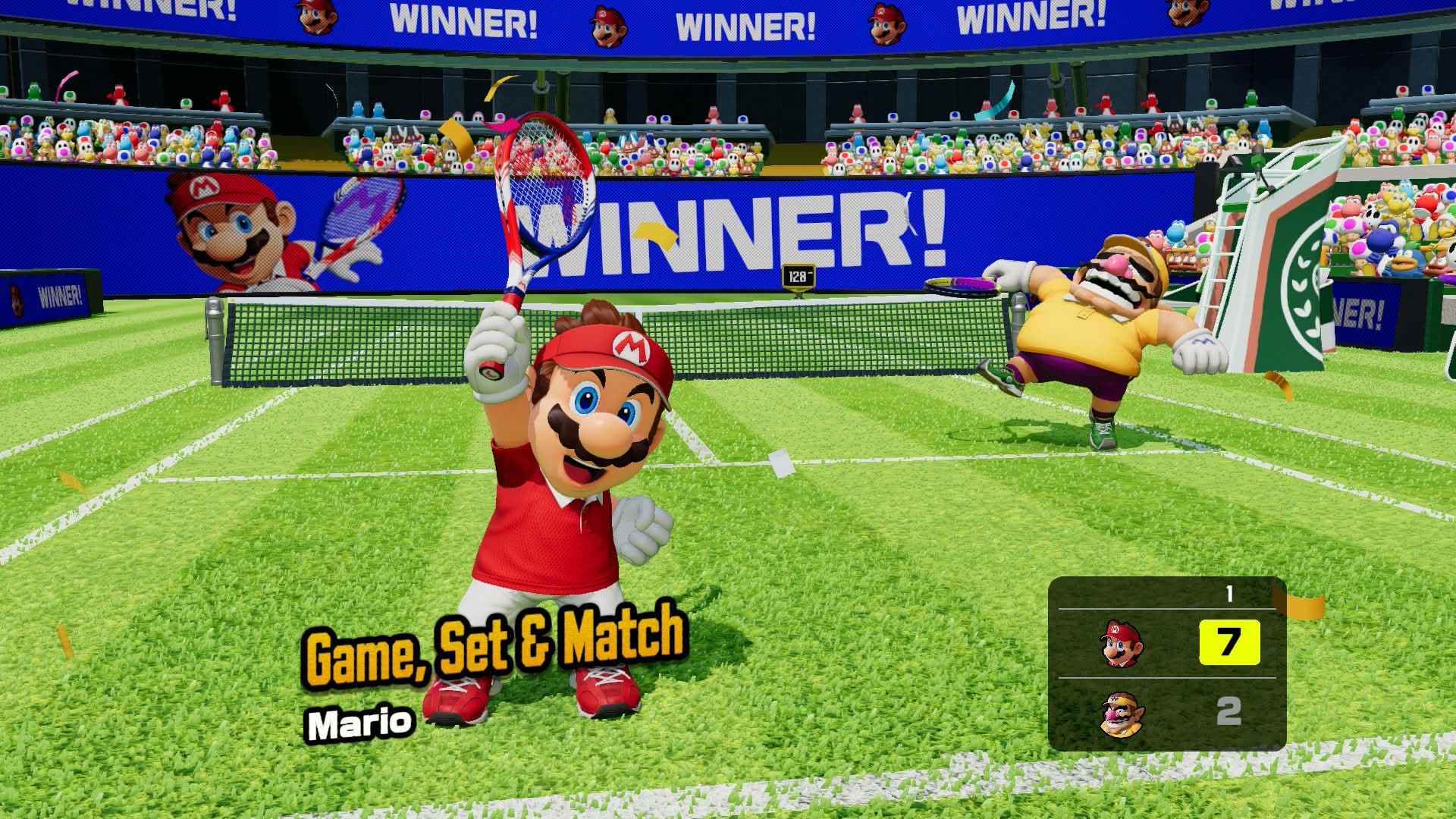
Back in the original Switch’s prime, I found myself pretty engrossed by the demo of Mario Tennis Aces. The trick shots and special moves were exciting to pull off, and the colourful particle effects looked sublime, especially when considering the meagrely powered Switch hardware. Those positive impressions influenced my decision to have a look at Mario Tennis Fever, and it’s okay… but I expected more.
On the court, it is fantastic from a gameplay standpoint. The team at Camelot have done a wonderful job of recapturing the excitement of watching tennis on television, from the drawn-out rallies to the newly introduced play-by-play commentary from Talking Flower, first introduced in Mario Wonder. The controls are responsive and the animation work is phenomenal. I particularly loved the attention to detail given to the movement of individual characters. Koopa Troopa, as an example, goes into his shell form and rolls around the court when chasing up the ball, whereas Luigi lumbers around the court holding the racket in one hand and having the other balled up into a fist, as if he is quietly irritated at having to play tennis instead of vacuuming abandoned mansions.
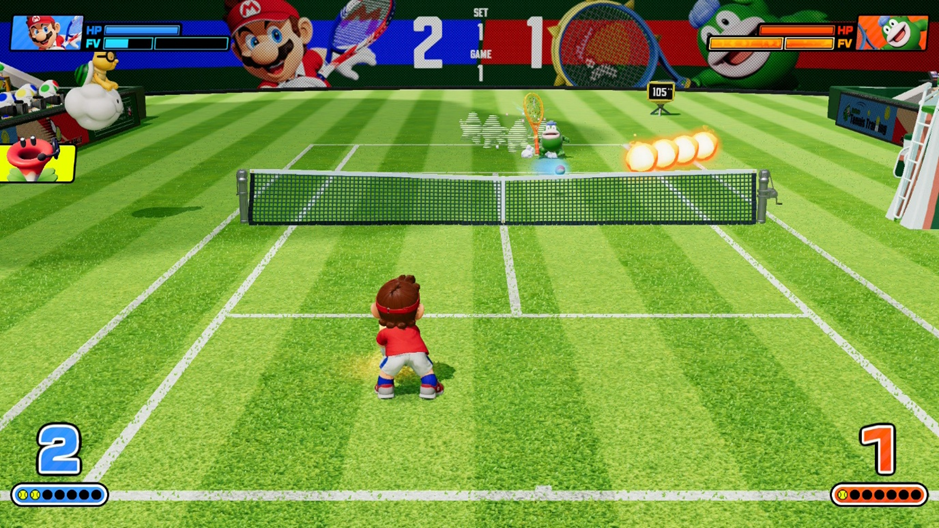
I also conducted some testing with the Swing Mode, which uses the Joy Con 2’s motion controls and came away impressed with the tracking accuracy on my swings. It is obviously not as responsive as the regular controls, where you can just tilt the sticks for directions, but as a novelty input type for younger or casual players, you could certainly do worse than the motion tracking present here.
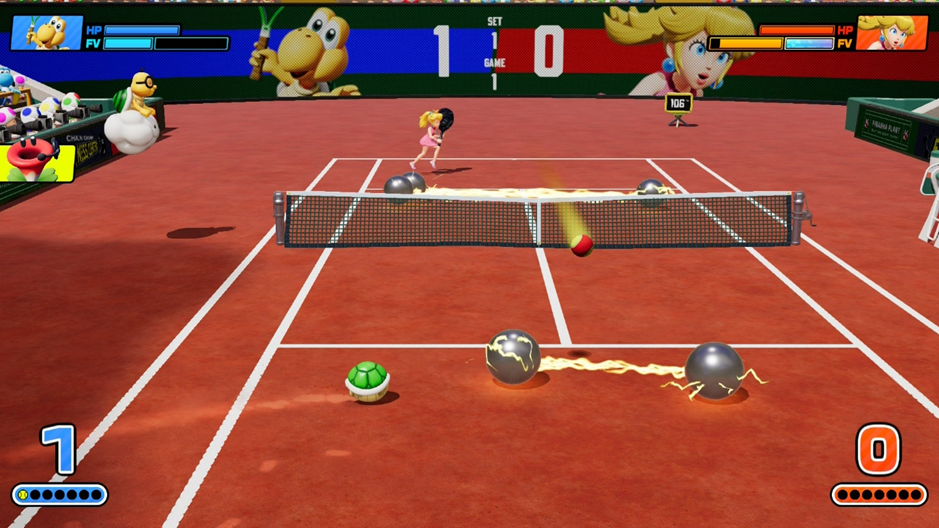
The namesake fever rackets are what take the on-court action to the next level. There are thirty of them in total, and each provides a unique ability that spices up rallies. Some are elemental based, like an ice or fire racket that applies that effect to the opponent’s side of the court, making it more difficult for them to move around without getting burnt or sliding on ice. I appreciated a few rackets in particular that were super clever; for example, the Amp Racket works by placing an amp conduit of sorts on the spot where a ball bounces, and a string of lightning connects to each subsequent conduit, creating a web of electrified barbed wire and preventing the opponent from getting close to the net.
It was exhilarating getting to experiment with different fever rackets and creating special strategies with each one. Early on I developed an effective combo with the Fire Bar Racket. Essentially I would hit a fever shot into the front right hand side of the opponent’s court, which would deploy the namesake Fire Bar that rotates in place, then I would hit a shot right in front of the Fire Bar, with extremely limited bounce, so the opponent would be forced to dive forward through the ring of fire just to return my shot.
I pulled off a similar tactic with the Amp Racket, but this time aiming my returns in a way that created a lightning tripwire pyramid of sorts in the middle of the court and then hitting balls straight into the middle to make life extra difficult for the opponent. Experimenting with these rackets was by far the most engaging aspect of my time with it.
If a player was not feeling strategic and just wanted to have fun, they could go with the more chaotic options like the Ty-Foo Racket, which unleashes tornados on the court, causing bedlam in the stadium, and even spinning the ball around if it gets caught up in one of them. I imagine this would all make for an incredible party experience because of both the chaotic and tactical energy these fever mechanics bring to the game, and of course the ability to play duos, so you can get up to four of your friends and family involved.
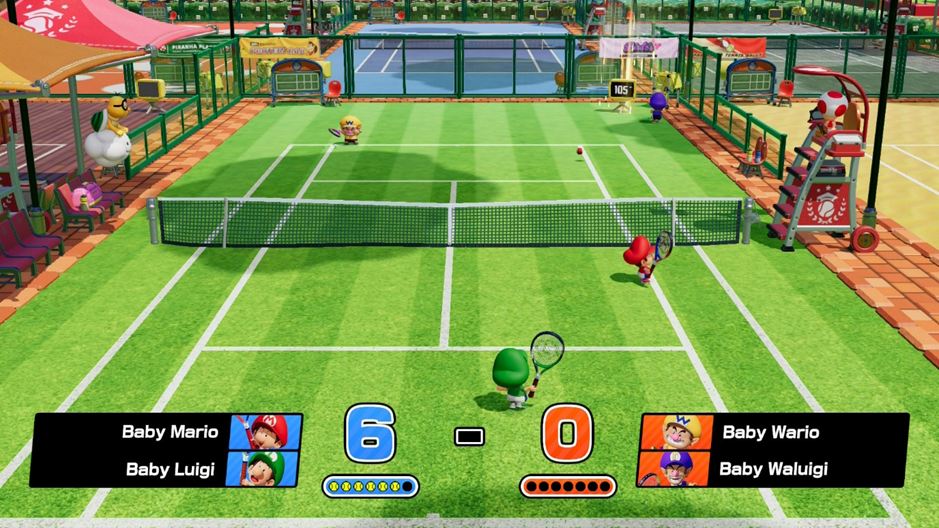
If you are a fan of traditional tennis, rest assured the game remains plenty fun to play without the fever rackets, but you will have to be an excellent player as the AI becomes quite competitive at the Pro difficulty level and above. I was pulling out my traditional tricks, lob shots to push the player back then a surprise dropshot close to their net to ensure they don’t make it back in time… except they did make it back and usually beat me for the point. Then I would try power shots to the left then right sides of their court, making the opponent ping back and forth like a pendulum, and yet, the AI managed to return every shot and still beat me.
It is only with those fever rackets that I managed to get the drop on the Pro difficulty AI, which encouraged me to experiment with the best ones and create unique plans to guarantee victory, like the strategy with the Fire Bar and Amp Rackets detailed earlier.
The reason I bring up the Pro difficulty is because I found that the AI was a bit too easy to exploit when set below that, so I would have liked a more balanced difficulty level slotted in between the Expert and Pro options. While we are on the topic of things I would have liked to see, while I enjoy the fever mechanics as they are, I found myself craving an unlockable racket that allowed for the combination of two or more of the other fever options to create a hybrid of sorts, so I would have access to more than the one fever trait during a match, which would have given me access to a broader range of tactics during rallies.
Courtside View
The visuals are another sticking point. Overall, Mario Tennis Fever looks good enough, but I do question some of the choices made with the presentation. Upon booting it up, I immediately noticed that it looked quite raw on my TV and confirmed the same issue was present in handheld mode after undocking; the game seems to use very little Anti-Aliasing (AA), which leads to raw edges anywhere where there are fine lines or smaller objects. You can spot this for yourself if you look closely at the net in front of Rosalina in the screenshot below.
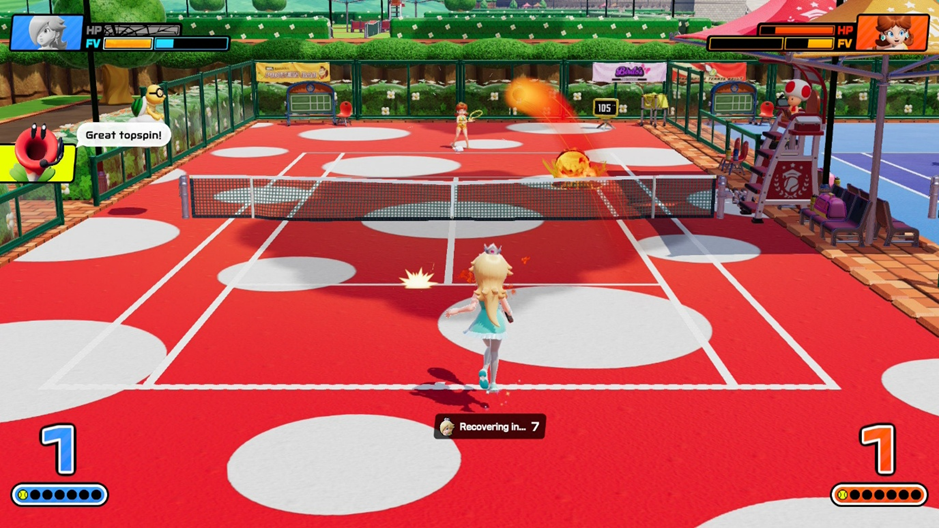
You can also spot sawtooth edges on the court markings underneath Rosalina, although those aren’t as distracting as the player’s eyes are naturally drawn to the middle to see which direction the ball is headed, and that is exactly where the rough edges on the net are. I am not entirely sure what kind of AA is being used here, but it is just not good enough for a full priced tennis game on a new hardware platform to features raw edges right in the middle of the screen.
And while I enjoyed the artwork and variety in the court designs, it feels like there is room here for the Switch 2 to render either more detailed visuals or the current presentation at a higher resolution, as this is clearly not outputting at anywhere near 4K in the TV mode. Last year’s Metroid Prime 4 did a much better job of taking advantage of the Switch 2’s hardware capabilities. It was also priced similarly to this, and lest we forget, was not even a current generation game… so why should Mario Tennis Fever get a break for not hitting that visual benchmark? If anything, it should look much better than Prime 4, considering how little it has to render in comparison to the sprawling environments in that game.
Conversely, the character models in Fever, much like the animation work, looks fantastic. I was super impressed with the way they handled clothing in this game, when playing as Mario for example, you can see how realistic the mesh fabric on his red shirt looks, and even the material used in his shoes look more lifelike than anything I have seen in a prior Nintendo title. I doubt there are many inspecting Mario’s shoes in a tennis game, but it really shows you how much work went into the character design. Similarly, the post-match crowd density looked incredible in the Stadium Courts, not only were there hundreds in attendance but the audience were all 3D models and had sufficient variety, instead of just being a dozen toads in different colours.
The NeverStarting Story
The Adventure mode begins with an hour and forty minute tutorial.
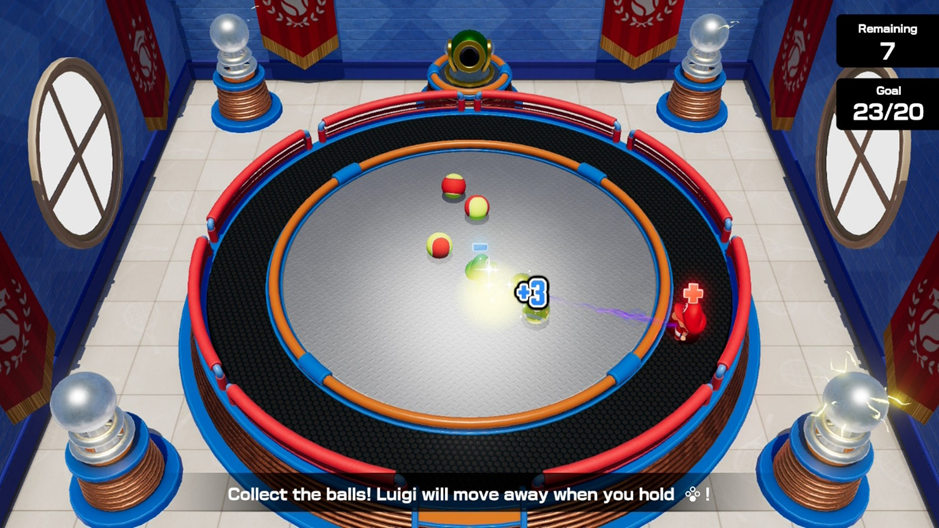
So, it goes without saying that the pacing here is rough. The story kicks off with an incredible looking pre-rendered cutscene where Mario and Luigi get turned into babies by misty purple monsters. How does the game follow this exciting sequence up? By having these baby brothers attend a tennis academy, where they do drills, quizzes and training minigames for what feels like an eternity. I can’t see anyone playing the opening hours of this mode and coming away with a positive impression, unless they hold some strange nostalgia for high school physical education classes.
It is simply not fun, and the tutorials being presented back-to-back makes the pacing feel even worse. You are essentially bombarded with information about tennis shots, court types and player traits, while questioning whether you are playing a video game or an interactive lesson at a real tennis academy.
On top of this, Talking Flower remains the primary and only voiced character in the story, which is bizarre because Waluigi and Wario have a ton of dialogue, but all of it is displayed in text boxes. It is 2026. If you are going to write dialogue for your characters, please hire voice actors to read the lines. It is a little disheartening to see a full priced game release on a modern platform, featuring scenes playing out with a still image in the background and static text boxes in the foreground.
After the extended academy sequence, the adventure mode does pick up with an exciting segment in the sky, where you use specific tennis shots to put fires out inside a ship. It continues to maintain this level of excitement as it progresses, although I must admit I never quite shook the memories of being forced back into PE class out of my mind while playing the better half of this mode. And unfortunately, they kept using the text boxes and still images for dialogue scenes, which were tough to look at.
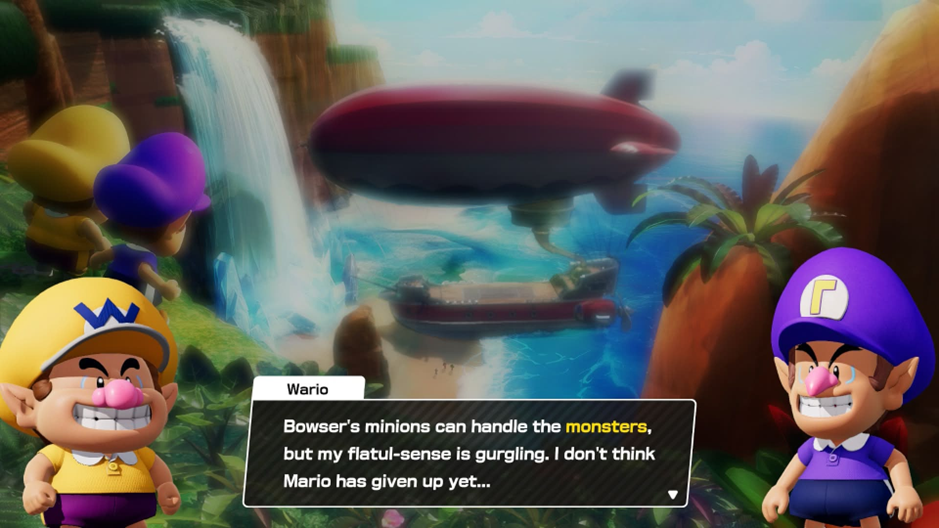
Suffice to say, this adventure was disappointing, and I really wish they cut the first hour and half of it out, or made that segment into a separate, dedicated ‘Academy’ mode. Throughout this review, I have hinted at my dissatisfaction with the price point of this title, and it has influenced a couple of my critiques that I would not have emphasised if we were dealing with a cheaper game. If you are going to deliver a sports title at a premium price, the bar has been set quite high by the WWE 2K series, with annual releases delivering over 50 hours of content and fully voiced cutscenes in the myRise narrative sections. Fever’s barebones modes and short story feel like a paltry offering in comparison.
Based on all of that, I would say at $50 AUD/$60 NZD, Mario Tennis Fever would be a great pick up for families and fans of the sport, due to the core gameplay being accessible and strong in its tennis Free Play mode. It is a real shame that the other modes do not offer enough to make this a worthwhile purchase at full price.
Reviewed on Nintendo Switch 2 with a code provided by the publisher.
On the court, Mario Tennis Fever offers entertaining, responsive Tennis action that makes the most out of its delightfully chaotic Fever system. Unfortunately, the overall package, especially its woefully paced adventure mode, falls short of the mark.
